It wasn't supposed to be a hit. It was supposed to be a jam, one more track to round out an album, cut in a hurry, built off a bassline Tom Browne had been carrying around in his head. Nobody in that room was chasing the radio. They were chasing a feeling. The radio found them anyway.
Play it now and the effect hasn't dulled. The bassline comes in first, rubbery and low. The handclaps follow, like a row of people slapping the dashboard in agreement. By the time the trumpet enters, regal and unhurried, you've already reached for the volume. Funkin' for Jamaica (N.Y.) did that in 1980. It still does it today, every time some driver stumbles onto those opening notes and decides the trip just got better.
A Love Letter With a Confusing Address
The title is a trap. Browne grew up in Jamaica, Queens (the neighborhood, not the island), and the song is a tribute to that block, not to Bob Marley's homeland. People misread it constantly. Listeners in the Caribbean assumed it was about their Jamaica. Residents of Queens were thrilled to hear their corner of New York get radio time for once. Browne leaned into the confusion so hard that he once played a show in the actual country of Jamaica, where the crowd knew every word and nobody cared about the geography.
Funkin' for Jamaica (N.Y.)
Listen while you read: Funkin' for Jamaica (N.Y.) | Love Approach | 1980
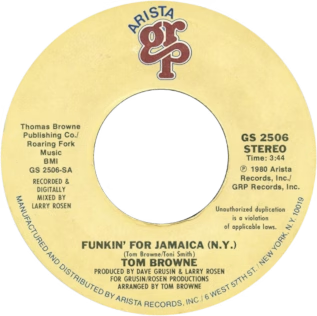
The single dropped in July 1980, the lead cut from Browne's second album, Love Approach, on Dave Grusin and Larry Rosen's GRP imprint through Arista. It hit number one on the Billboard R&B chart and camped there for four weeks. It reached number nine on the dance chart. It cracked the UK top ten. And it never touched the pop Hot 100, which sounds like a footnote until you sit with how strange that actually is. A four-week R&B number one, invisible to pop radio. Billboard later cited it as a case study in the limits of crossover: dominant on Black radio and the dance floor, a ghost on the mainstream chart. Nobody who bought the record cared. It sold anyway.
The Bassline in the Attic
Here's the part that explains everything: the song almost didn't exist. Browne had already finished Love Approach when the label came back and said the album needed one more track. So he did what jazz musicians do when they need an idea: he sat in his parents' attic and let a bassline loop in his head until it meant something. The next morning he brought it to the studio and handed it to Bernard Wright, a fifteen-year-old keyboardist from the neighborhood. They built the record from the bottom up, concept stacked on concept, each musician layering in his own personality instead of following a chart someone else had written.
The result is a jam session wearing a pop single as a disguise. Wright's electric piano and Prophet synth became the record's center of gravity. Everything else locks in around it: Marcus Miller on bass, Buddy Williams on drums, Bobby Broom on guitar, Errol "Crusher" Bennett on percussion, Dave Grusin on acoustic piano. Browne layered in trumpet and handclaps. The credits read like a roll call of what Queens was about to become.
These were the Jamaica Kats: young players from Jamaica, St. Albans, and Hollis who'd grown up jamming at the Village Door and in each other's basements. Weldon Irvine, the pianist and composer who'd once been Nina Simone's musical director, and Lenny White, the drummer from Bitches Brew, were the elders in the room. Irvine didn't just teach music. He handed out life advice, put young players into working situations, and eased them toward careers. The Kats treated jazz and funk as one language. This record is the sentence they said together.
The Voice That Wasn't Chaka
The most misread credit belongs to the singer. Toni Smith, full name Thomassina Carrollyne Smith, sang lead and co-wrote the song with Browne. Her voice is the reason the record has its heat: sensual, urgent, almost gospel. People kept mistaking her for Chaka Khan. The mistake traveled so far it reportedly reached Khan herself, who heard the record and thought she'd recorded it. AllMusic notes the confusion in its review. That's the polite way of saying Smith delivered a vocal so commanding that people refused to believe it belonged to someone they'd never heard of. She should have been famous off this one performance alone.
Alvin "Winky" Flythe adds spoken interludes, street-level patter name-checking 165th Street Mall and Club Fantasia. Eleven names on the credits are listed for handclaps alone. You can hear why. The record sounds like people are inside the groove, not layered on top of it.
Jamaica funk, that's what it is Let it get into you
Becoming Captain Tom
Tom Browne
Here's the joke at the center of the story: Tom Browne was a jazz trumpet player who got cast as a funkster and spent the rest of his career explaining the mix-up. He trained classically, studied under the principal trumpet from Toscanini's orchestra, and won a scholarship to the High School of Music and Art. His debut, Browne Sugar, marked him as a jazz-fusion player, full stop. When the label wanted a hit, George Benson made the case that an artist shouldn't be denied one. Clive Davis reluctantly agreed. He thought the track was too commercial for a jazz artist. He was right, and it didn't matter. The record became a phenomenon, and Browne became famous for a sound that was never his primary direction.
He called it a blessing and a curse, all in one breath. Two notes of trumpet, more popular than anything else he'd ever play, no matter how much he played. The industry wanted another Funkin' for Jamaica. Browne wanted to play straight-ahead jazz. He never replicated the peak. He released a run of albums that found their own audiences without finding that lightning again, and then did something nobody expected: he became a commercial airline pilot, partly to pay the bills. Somewhere above the clouds, the man behind the most recognizable trumpet riff in jazz-funk was flying 747s.
Never Finished Being Sampled
The record's second life started almost immediately. The Evasions built a track around its groove in 1981, and that same groove kept turning up for decades after: in hits by Coolio, Tone Loc, Mariah Carey and Mystikal, N.W.A, EPMD, Snoop Dogg, Keith Murray, and Erykah Badu. Every one of them heard the same thing the rest of us hear from the driver's seat: this groove was built to be reused, and it keeps finding new drivers.
The Jamaica Kats scattered and became exactly what their talent promised. Marcus Miller turned into one of the defining bassists and producers of the '80s and '90s. Omar Hakim became an elite session drummer and joined Weather Report. Bernard Wright became a cult figure in funk and R&B keyboards before his death in 2022. Bobby Broom became a respected jazz guitarist. Weldon Irvine's lessons rippled through the business via the players he'd shaped. GRP itself shifted direction because of this one record, chasing the hybrid jazz-funk sound the Kats had just proven the market wanted.
It wasn't supposed to be a hit. It was supposed to be one more track, a jam cut in a hurry by a jazz trumpet player who wanted nothing to do with pop radio. Forty-five years later, the bassline a fifteen-year-old played in a rush still sounds like the future, and the man who made it spent the rest of his life trying to convince people he was never really trying to make it at all.
One song delivered to your inbox every Sunday morning.
Join the readers who start their Sunday with a story they didn't know they needed.
The Sunday Drop
One song. One story. Every Sunday.
No algorithms. No trending sections. Just a song someone loved and the story behind it. Delivered Sunday morning.
✓Check your email to confirm.
Free. No spam. Unsubscribe anytime.
Image Credits
1,449 artist portraits across 5 genres (Rock, Jazz, Soul, Blues, Folk).
1,363 sourced from Wikipedia (Creative Commons / Public Domain), 50 from
Deezer (promotional artwork).
It wasn't supposed to be a hit. It was supposed to be a jam, one more track to round out an album, cut in a hurry, built off a bassline Tom Browne had been carrying around in his head. Nobody in that room was chasing the radio. They were chasing a feeling. The radio found them anyway.
Play it now and the effect hasn't dulled. The bassline comes in first, rubbery and low. The handclaps follow, like a row of people slapping the dashboard in agreement. By the time the trumpet enters, regal and unhurried, you've already reached for the volume. Funkin' for Jamaica (N.Y.) did that in 1980. It still does it today, every time some driver stumbles onto those opening notes and decides the trip just got better.
A Love Letter With a Confusing Address
The title is a trap. Browne grew up in Jamaica, Queens (the neighborhood, not the island), and the song is a tribute to that block, not to Bob Marley's homeland. People misread it constantly. Listeners in the Caribbean assumed it was about their Jamaica. Residents of Queens were thrilled to hear their corner of New York get radio time for once. Browne leaned into the confusion so hard that he once played a show in the actual country of Jamaica, where the crowd knew every word and nobody cared about the geography.
Funkin' for Jamaica (N.Y.)
Listen while you read: Funkin' for Jamaica (N.Y.) | Love Approach | 1980
The single dropped in July 1980, the lead cut from Browne's second album, Love Approach, on Dave Grusin and Larry Rosen's GRP imprint through Arista. It hit number one on the Billboard R&B chart and camped there for four weeks. It reached number nine on the dance chart. It cracked the UK top ten. And it never touched the pop Hot 100, which sounds like a footnote until you sit with how strange that actually is. A four-week R&B number one, invisible to pop radio. Billboard later cited it as a case study in the limits of crossover: dominant on Black radio and the dance floor, a ghost on the mainstream chart. Nobody who bought the record cared. It sold anyway.
The Bassline in the Attic
Here's the part that explains everything: the song almost didn't exist. Browne had already finished Love Approach when the label came back and said the album needed one more track. So he did what jazz musicians do when they need an idea: he sat in his parents' attic and let a bassline loop in his head until it meant something. The next morning he brought it to the studio and handed it to Bernard Wright, a fifteen-year-old keyboardist from the neighborhood. They built the record from the bottom up, concept stacked on concept, each musician layering in his own personality instead of following a chart someone else had written.
The result is a jam session wearing a pop single as a disguise. Wright's electric piano and Prophet synth became the record's center of gravity. Everything else locks in around it: Marcus Miller on bass, Buddy Williams on drums, Bobby Broom on guitar, Errol "Crusher" Bennett on percussion, Dave Grusin on acoustic piano. Browne layered in trumpet and handclaps. The credits read like a roll call of what Queens was about to become.
These were the Jamaica Kats: young players from Jamaica, St. Albans, and Hollis who'd grown up jamming at the Village Door and in each other's basements. Weldon Irvine, the pianist and composer who'd once been Nina Simone's musical director, and Lenny White, the drummer from Bitches Brew, were the elders in the room. Irvine didn't just teach music. He handed out life advice, put young players into working situations, and eased them toward careers. The Kats treated jazz and funk as one language. This record is the sentence they said together.
The Voice That Wasn't Chaka
The most misread credit belongs to the singer. Toni Smith, full name Thomassina Carrollyne Smith, sang lead and co-wrote the song with Browne. Her voice is the reason the record has its heat: sensual, urgent, almost gospel. People kept mistaking her for Chaka Khan. The mistake traveled so far it reportedly reached Khan herself, who heard the record and thought she'd recorded it. AllMusic notes the confusion in its review. That's the polite way of saying Smith delivered a vocal so commanding that people refused to believe it belonged to someone they'd never heard of. She should have been famous off this one performance alone.
Alvin "Winky" Flythe adds spoken interludes, street-level patter name-checking 165th Street Mall and Club Fantasia. Eleven names on the credits are listed for handclaps alone. You can hear why. The record sounds like people are inside the groove, not layered on top of it.
Jamaica funk, that's what it is Let it get into you
Becoming Captain Tom
Tom Browne
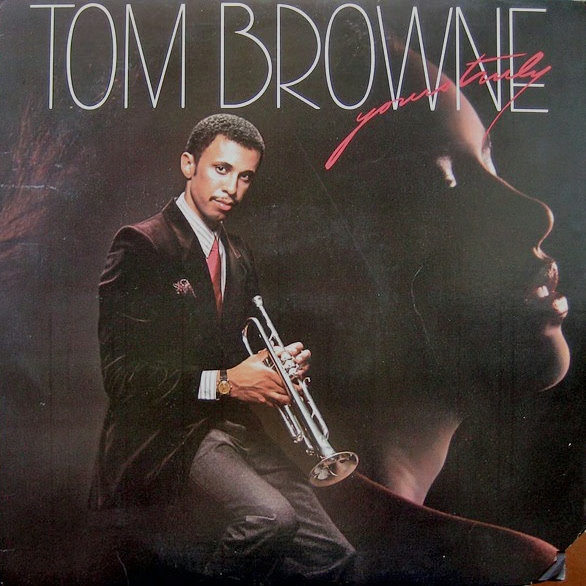
Here's the joke at the center of the story: Tom Browne was a jazz trumpet player who got cast as a funkster and spent the rest of his career explaining the mix-up. He trained classically, studied under the principal trumpet from Toscanini's orchestra, and won a scholarship to the High School of Music and Art. His debut, Browne Sugar, marked him as a jazz-fusion player, full stop. When the label wanted a hit, George Benson made the case that an artist shouldn't be denied one. Clive Davis reluctantly agreed. He thought the track was too commercial for a jazz artist. He was right, and it didn't matter. The record became a phenomenon, and Browne became famous for a sound that was never his primary direction.
He called it a blessing and a curse, all in one breath. Two notes of trumpet, more popular than anything else he'd ever play, no matter how much he played. The industry wanted another Funkin' for Jamaica. Browne wanted to play straight-ahead jazz. He never replicated the peak. He released a run of albums that found their own audiences without finding that lightning again, and then did something nobody expected: he became a commercial airline pilot, partly to pay the bills. Somewhere above the clouds, the man behind the most recognizable trumpet riff in jazz-funk was flying 747s.
Never Finished Being Sampled
The record's second life started almost immediately. The Evasions built a track around its groove in 1981, and that same groove kept turning up for decades after: in hits by Coolio, Tone Loc, Mariah Carey and Mystikal, N.W.A, EPMD, Snoop Dogg, Keith Murray, and Erykah Badu. Every one of them heard the same thing the rest of us hear from the driver's seat: this groove was built to be reused, and it keeps finding new drivers.
The Jamaica Kats scattered and became exactly what their talent promised. Marcus Miller turned into one of the defining bassists and producers of the '80s and '90s. Omar Hakim became an elite session drummer and joined Weather Report. Bernard Wright became a cult figure in funk and R&B keyboards before his death in 2022. Bobby Broom became a respected jazz guitarist. Weldon Irvine's lessons rippled through the business via the players he'd shaped. GRP itself shifted direction because of this one record, chasing the hybrid jazz-funk sound the Kats had just proven the market wanted.
It wasn't supposed to be a hit. It was supposed to be one more track, a jam cut in a hurry by a jazz trumpet player who wanted nothing to do with pop radio. Forty-five years later, the bassline a fifteen-year-old played in a rush still sounds like the future, and the man who made it spent the rest of his life trying to convince people he was never really trying to make it at all.