I didn’t hear much about Betty Davis growing up, and it wasn’t for lack of talent. Say her name and half the room still pictures Bette Davis, the actress with enormous eyes and cigarette smoke. This Betty spelled her name with a Y, and she was busy inventing a sound nobody had made before. What kept people from finding her wasn’t the spelling. It was radio refusing her, an impatient industry, and a culture not ready to hear a Black woman name exactly what she wanted--and refuse to give it up. It took the world fifty years to catch up. It was worth the wait.
Start with the room. Wally Heider Studios, San Francisco, 1972. A twenty-eight-year-old woman leans into the microphone, and behind her stands a murderers’ row of Bay Area funk: Larry Graham on bass, Neal Schon on guitar, Merl Saunders on keys, the Pointer Sisters and Sylvester stacked on backing vocals. A drummer who barely knew her pulled them all into one room because she asked. Betty Davis wasn’t asking anymore. She was telling. She’d been telling since she pointed her husband toward Hendrix and Sly Stone, then walked out of a marriage that reshaped jazz fusion and kept the name.
The song she cut that day is a list. Across four and a half minutes, Betty itemizes every reason she won’t fall for the man in front of her, each one doubling as a confession of what he could take from her if she let him. “I know you could possess my body. I know you could make me crawl. I know you could have me shaking, climbing the walls.” The song knows the price of loving him and refuses to pay it.
Anti Love Song
Listen while you read: Anti Love Song | Betty Davis | 1973
That refusal was forged around hot metal. Her father Henry worked the steel mills of Homestead, Pennsylvania, part of the Great Migration that carried the family north from North Carolina. The woman who sang “you’d scorch it just like hot iron” grew up near those furnaces. That wasn’t a borrowed metaphor. It was the air of her hometown.
The resulting album, Betty Davis, dropped in 1973 on Just Sunshine Records: twenty-nine minutes of hard funk radio wouldn’t touch. All eight songs were hers, written, arranged, and self-published by a woman already told her sound wasn’t welcome. It went nowhere on the charts, and has never stopped finding listeners. AllMusic eventually gave it four and a half stars, and Pitchfork scored it 8.9. None of that acclaim arrived in 1973; it came decades later, after she’d walked away.
The Case She States
Anti Love Song works because it refuses to cast her as a victim. She names her opponent’s power and her own in the same breath, almost daring him to call the bluff. “You know I could possess your body too. You know I could make you crawl. And just as hard as I fall for you, boy, you know you’d fall for me harder.” Poet Harmony Holiday hears a creation myth in it: a woman inventing herself by naming what she won’t accept. She refuses to be the shelf where someone else’s ego rests. She says yes to herself instead.
“’Cause I know you could possess my body I know you could make me crawl I know you could have me shaking I know you could have me climbing the walls That’s why I don’t wanna love you”
The performance carries that argument. Betty sings in a low, predatory whisper, then cracks it into a raspy shriek, until the song sounds like a cross-examination by someone who already knows she’s won. The Guardian’s Stevie Chick called that voice erotic sandpaper, making Janis Joplin sound like Dionne Warwick by comparison. Larry Graham’s slap bass locks the groove to the floor while Greg Errico’s drums ride the edge of chaos. Down and dirty funk, Errico called it, and that’s the whole thesis in four words.
He’d put that band together in an afternoon, after Santana’s Michael Carabello, who was dating Betty, brought her to the studio. By day’s end, she’d asked him to produce her record. That’s Betty Davis in miniature: walk in, hear the room, own it before sundown.
The Steel Town and the Cellar
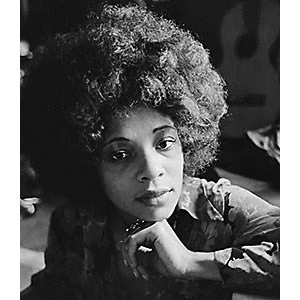
Betty Davis.
Born Betty Gray Mabry on July 26, 1944, in Durham, she spent childhood summers on her grandmother’s Reidsville farm, where the blues came through family, records, and the air itself: B.B. King, Muddy Waters, Jimmy Reed, Elmore James, Big Mama Thornton. She wrote her first song by twelve, called “I’m Going to Bake That Cake of Love.” Musicologist Danielle Maggio has argued this is exactly why Betty’s voice never picked up the church melisma that smoothed so many other soul singers for the industry. The gospel ornaments were never hers to lose. The family moved to Homestead when the steel plants hired her father, and Betty came of age in a town with its own idea of what it takes to be heard over machinery.
At sixteen she left for New York and enrolled at the Fashion Institute of Technology; the real education came after class. She modeled for Seventeen, Ebony, and Glamour, and held court at the Cellar, where the city’s stylish young everything gathered. She spun records, worked the room, and got close to Jimi Hendrix and Sly Stone before the world knew either name. She was a songwriter before a singer; the the Chambers Brothers cut her “Uptown (to Harlem)” in 1967, and she’d already released “Get Ready for Betty” back in 1964, under her birth name. By the time she married Miles Davis in September 1968, she was already a force on the scene in her own right, not his appendage.
The marriage lasted about a year and remade his music. She introduced him to Hendrix and to Sly, pushed electric sounds into his ears, and appeared on the cover of Filles de Kilimanjaro, which carried a song written for her. Bitches Brew followed soon after. Miles later wrote that if Betty were singing today, she’d be something like Madonna or Prince, only as a woman, and that she was the beginning of all that. The divorce was bitter. Betty kept the name anyway. It was hers now.
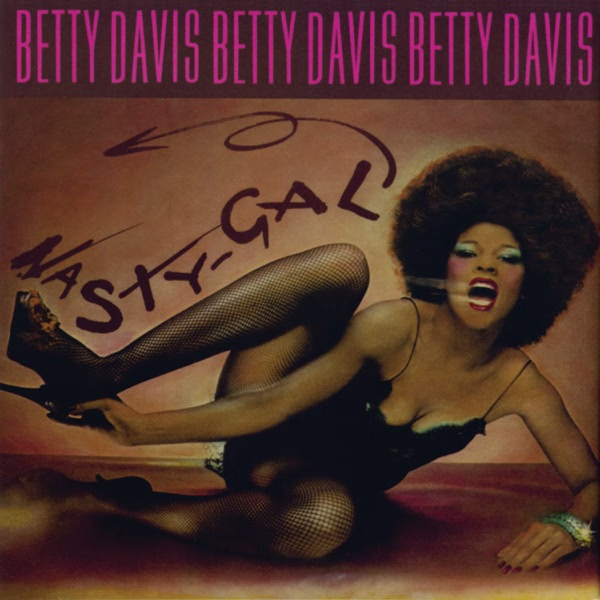
They Say I’m Different (1974)Nasty Gal (1975)
They Say I’m Different (1974) and Nasty Gal (1975) kept the standard high and radio far away. The songs were banned from airplay, boycotted by religious groups, and attacked by an NAACP demanding Black radio drop them. Betty’s reply was pure steel town: “I’m coloured and they’re stopping my advancement!” She was barred from American television for a stage persona deemed too explicit and aggressive. None sold. All kept working, slow-fuse style, on everyone who eventually heard them.
Island shelved her fourth album, recorded in 1976, for thirty-three years. She spent a year in Japan among silent monks. Her father died in 1980, and she came home to Homestead to live with her mother, then retreated further, to a quiet house at the end of a career she had stopped fighting for. Light in the Attic reissued the early albums in 2007 to a generation that had never heard her. A 2017 documentary, Betty: They Say I’m Different, tracked her down living in a basement with no internet or phone. She released one new song in 2019, sung by friend Danielle Maggio. Cancer took her on February 9, 2022, at home in Homestead. She was seventy-seven.
The lineage is easy to hear once you know what you’re listening for. Prince’s early funk. Macy Gray’s rasp. Madonna’s provocation. The swagger of Millie Jackson, Erykah Badu, and Missy Elliott. Soul Jazz Review put it plainly: “Anti Love Song” is why Betty Davis is the undisputed Queen of Funk. Hanif Abdurraqib, writing at her death, said it best of all: you’ve heard her, even if you think you’ve never heard her.
I didn’t know Betty Davis growing up. I know her now, and I can’t stop. Radio locked her out for fifty years. She locked right back. Between them, a bloodline of funk and nerve got built without permission. The heat didn’t die. It just too its time.
One song delivered to your inbox every Sunday morning.
Join the readers who start their Sunday with a story they didn't know they needed.
The Sunday Drop
One song. One story. Every Sunday.
No algorithms. No trending sections. Just a song someone loved and the story behind it. Delivered Sunday morning.
✓Check your email to confirm.
Free. No spam. Unsubscribe anytime.
Image Credits
1,449 artist portraits across 5 genres (Rock, Jazz, Soul, Blues, Folk).
1,363 sourced from Wikipedia (Creative Commons / Public Domain), 50 from
Deezer (promotional artwork).
I didn’t hear much about Betty Davis growing up, and it wasn’t for lack of talent. Say her name and half the room still pictures Bette Davis, the actress with enormous eyes and cigarette smoke. This Betty spelled her name with a Y, and she was busy inventing a sound nobody had made before. What kept people from finding her wasn’t the spelling. It was radio refusing her, an impatient industry, and a culture not ready to hear a Black woman name exactly what she wanted--and refuse to give it up. It took the world fifty years to catch up. It was worth the wait.
Start with the room. Wally Heider Studios, San Francisco, 1972. A twenty-eight-year-old woman leans into the microphone, and behind her stands a murderers’ row of Bay Area funk: Larry Graham on bass, Neal Schon on guitar, Merl Saunders on keys, the Pointer Sisters and Sylvester stacked on backing vocals. A drummer who barely knew her pulled them all into one room because she asked. Betty Davis wasn’t asking anymore. She was telling. She’d been telling since she pointed her husband toward Hendrix and Sly Stone, then walked out of a marriage that reshaped jazz fusion and kept the name.
The song she cut that day is a list. Across four and a half minutes, Betty itemizes every reason she won’t fall for the man in front of her, each one doubling as a confession of what he could take from her if she let him. “I know you could possess my body. I know you could make me crawl. I know you could have me shaking, climbing the walls.” The song knows the price of loving him and refuses to pay it.
Anti Love Song
Listen while you read: Anti Love Song | Betty Davis | 1973
That refusal was forged around hot metal. Her father Henry worked the steel mills of Homestead, Pennsylvania, part of the Great Migration that carried the family north from North Carolina. The woman who sang “you’d scorch it just like hot iron” grew up near those furnaces. That wasn’t a borrowed metaphor. It was the air of her hometown.
The resulting album, Betty Davis, dropped in 1973 on Just Sunshine Records: twenty-nine minutes of hard funk radio wouldn’t touch. All eight songs were hers, written, arranged, and self-published by a woman already told her sound wasn’t welcome. It went nowhere on the charts, and has never stopped finding listeners. AllMusic eventually gave it four and a half stars, and Pitchfork scored it 8.9. None of that acclaim arrived in 1973; it came decades later, after she’d walked away.
The Case She States
Anti Love Song works because it refuses to cast her as a victim. She names her opponent’s power and her own in the same breath, almost daring him to call the bluff. “You know I could possess your body too. You know I could make you crawl. And just as hard as I fall for you, boy, you know you’d fall for me harder.” Poet Harmony Holiday hears a creation myth in it: a woman inventing herself by naming what she won’t accept. She refuses to be the shelf where someone else’s ego rests. She says yes to herself instead.
“’Cause I know you could possess my body I know you could make me crawl I know you could have me shaking I know you could have me climbing the walls That’s why I don’t wanna love you”
The performance carries that argument. Betty sings in a low, predatory whisper, then cracks it into a raspy shriek, until the song sounds like a cross-examination by someone who already knows she’s won. The Guardian’s Stevie Chick called that voice erotic sandpaper, making Janis Joplin sound like Dionne Warwick by comparison. Larry Graham’s slap bass locks the groove to the floor while Greg Errico’s drums ride the edge of chaos. Down and dirty funk, Errico called it, and that’s the whole thesis in four words.
He’d put that band together in an afternoon, after Santana’s Michael Carabello, who was dating Betty, brought her to the studio. By day’s end, she’d asked him to produce her record. That’s Betty Davis in miniature: walk in, hear the room, own it before sundown.
The Steel Town and the Cellar
Betty Davis.
Born Betty Gray Mabry on July 26, 1944, in Durham, she spent childhood summers on her grandmother’s Reidsville farm, where the blues came through family, records, and the air itself: B.B. King, Muddy Waters, Jimmy Reed, Elmore James, Big Mama Thornton. She wrote her first song by twelve, called “I’m Going to Bake That Cake of Love.” Musicologist Danielle Maggio has argued this is exactly why Betty’s voice never picked up the church melisma that smoothed so many other soul singers for the industry. The gospel ornaments were never hers to lose. The family moved to Homestead when the steel plants hired her father, and Betty came of age in a town with its own idea of what it takes to be heard over machinery.
At sixteen she left for New York and enrolled at the Fashion Institute of Technology; the real education came after class. She modeled for Seventeen, Ebony, and Glamour, and held court at the Cellar, where the city’s stylish young everything gathered. She spun records, worked the room, and got close to Jimi Hendrix and Sly Stone before the world knew either name. She was a songwriter before a singer; the the Chambers Brothers cut her “Uptown (to Harlem)” in 1967, and she’d already released “Get Ready for Betty” back in 1964, under her birth name. By the time she married Miles Davis in September 1968, she was already a force on the scene in her own right, not his appendage.
The marriage lasted about a year and remade his music. She introduced him to Hendrix and to Sly, pushed electric sounds into his ears, and appeared on the cover of Filles de Kilimanjaro, which carried a song written for her. Bitches Brew followed soon after. Miles later wrote that if Betty were singing today, she’d be something like Madonna or Prince, only as a woman, and that she was the beginning of all that. The divorce was bitter. Betty kept the name anyway. It was hers now.
They Say I’m Different (1974)Nasty Gal (1975)
They Say I’m Different (1974) and Nasty Gal (1975) kept the standard high and radio far away. The songs were banned from airplay, boycotted by religious groups, and attacked by an NAACP demanding Black radio drop them. Betty’s reply was pure steel town: “I’m coloured and they’re stopping my advancement!” She was barred from American television for a stage persona deemed too explicit and aggressive. None sold. All kept working, slow-fuse style, on everyone who eventually heard them.
Island shelved her fourth album, recorded in 1976, for thirty-three years. She spent a year in Japan among silent monks. Her father died in 1980, and she came home to Homestead to live with her mother, then retreated further, to a quiet house at the end of a career she had stopped fighting for. Light in the Attic reissued the early albums in 2007 to a generation that had never heard her. A 2017 documentary, Betty: They Say I’m Different, tracked her down living in a basement with no internet or phone. She released one new song in 2019, sung by friend Danielle Maggio. Cancer took her on February 9, 2022, at home in Homestead. She was seventy-seven.
The lineage is easy to hear once you know what you’re listening for. Prince’s early funk. Macy Gray’s rasp. Madonna’s provocation. The swagger of Millie Jackson, Erykah Badu, and Missy Elliott. Soul Jazz Review put it plainly: “Anti Love Song” is why Betty Davis is the undisputed Queen of Funk. Hanif Abdurraqib, writing at her death, said it best of all: you’ve heard her, even if you think you’ve never heard her.
I didn’t know Betty Davis growing up. I know her now, and I can’t stop. Radio locked her out for fifty years. She locked right back. Between them, a bloodline of funk and nerve got built without permission. The heat didn’t die. It just too its time.