Louis Armstrong tracklist updated 08/2026
"Hello, Dolly This is Louis, Dolly"
-- from Hello, Dolly!
He was born in 1901 in New Orleans to a teenage mother, grew up poor in a rough neighborhood called the Battlefield, and found his direction in a reform school, where a music teacher picked him as bandleader. A Lithuanian Jewish family he worked for gave him the money for his first cornet and taught him to sing from the heart; he wore a Star of David for the rest of his life in their honor. He played the riverboats, studied under King Oliver, and by the mid-1920s was the most imitated trumpet player in America, winning cutting contests and blowing notes nobody else could reach. With his Hot Five he recorded the solos that young musicians memorized note for note, and when his sheet music fell on the floor during a session he kept the take going with nonsense syllables, inventing scat on the spot.
He moved to New York in 1929 and slowly transformed himself from trumpet virtuoso into a singer of popular standards, taking the same songs the white bands were playing and filling them with swing, sex and slang, changing the sound of music and the shape of the culture with every record. He survived the Depression when the big bands collapsed around him, became the first Black man to host a national radio show, and in 1947 slimmed down to a six-piece group, the All-Stars, which he led for the rest of his life. In 1964, at sixty-two, he knocked the Beatles off the top of the charts with Hello, Dolly!, the oldest artist ever to have a number one record.
He was born in 1901 in New Orleans to a teenage mother, grew up poor in a rough neighborhood called the Battlefield, and found his direction in a reform school, where a music teacher picked him as bandleader. A Lithuanian Jewish family he worked for gave him the money for his first cornet and taught him to sing from the heart; he wore a Star of David for the rest of his life in their honor. He played the riverboats, studied under King Oliver, and by the mid-1920s was the most imitated trumpet player in America, winning cutting contests and blowing notes nobody else could reach. With his Hot Five he recorded the solos that young musicians memorized note for note, and when his sheet music fell on the floor during a session he kept the take going with nonsense syllables, inventing scat on the spot.
He moved to New York in 1929 and slowly transformed himself from trumpet virtuoso into a singer of popular standards, taking the same songs the white bands were playing and filling them with swing, sex and slang, changing the sound of music and the shape of the culture with every record. He survived the Depression when the big bands collapsed around him, became the first Black man to host a national radio show, and in 1947 slimmed down to a six-piece group, the All-Stars, which he led for the rest of his life. In 1964, at sixty-two, he knocked the Beatles off the top of the charts with Hello, Dolly!, the oldest artist ever to have a number one record.
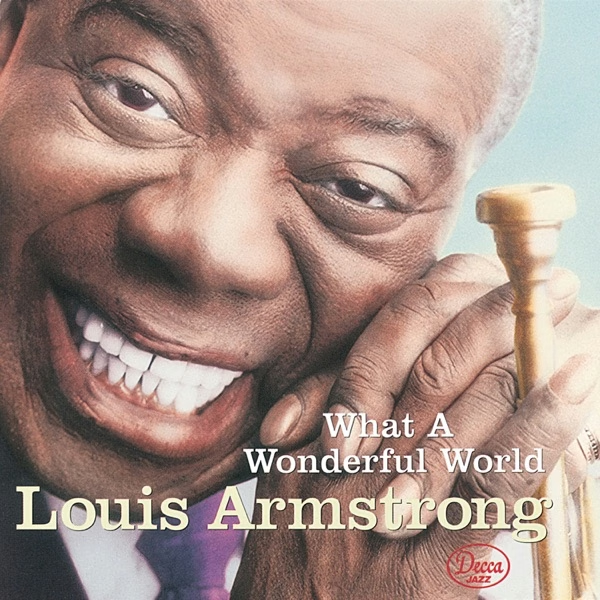
He was unapologetically Black in a country that wanted him to apologize for it. He took his stand in 1957 over the Little Rock school crisis, refusing a State Department tour and calling out the president publicly. Younger Black musicians criticized him for smiling too much; he did not care, having earned the right to define his own dignity. What a Wonderful World, recorded in his sixties, became the summary of his life and the adopted hymn of every generation since. He died in 1971, and his version of Melancholy Blues went into space on the Voyager Golden Record. He is the reason jazz has a face and a sound and a soloist's art, and the reason that art smiles.
Sources: Hotsupper research, Wikipedia, Ricky Riccardi (Heart Full of Rhythm, Oxford University Press; Louis Armstrong House Museum), Wikidata
Louis Armstrong was profiled in the documentary, Black & Blues, in 2022.