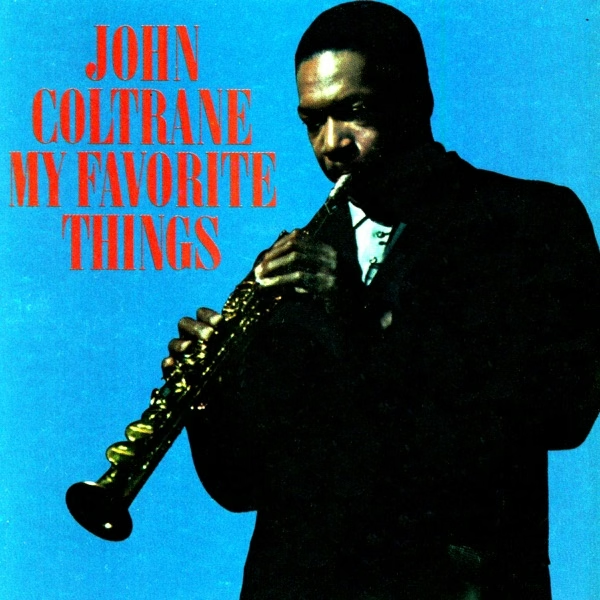
John Coltrane tracklist updated 08/2026
Born in 1926 in Hamlet, North Carolina, a railroad town where his father played violin and his mother sang in the church choir, Coltrane lost both his father and his grandfather within months of each other when he was twelve. The family moved to High Point. The saxophone became the thing he held onto. He played in the community band, studied at the Ornstein School of Music in Philadelphia after high school, and spent his Navy service playing in a segregated band in Hawaii. The years that followed were a masterclass in proximity: Dizzy Gillespie's big band, Jimmy Smith's small groups, and in 1955, the call from Miles Davis. But the heroin habit he had picked up in the early fifties followed him into the quintet, and Miles fired him in 1957. That firing was the turning point. Coltrane went cold, experienced what he described as a spiritual awakening, and came back playing with an intensity that made everything before it sound like a warmup.
The transformation was not subtle. By 1961, Coltrane's music had become so demanding, so dense, so far beyond what jazz audiences expected, that Down Beat magazine published a review calling it "anti-jazz" -- a horrifying demonstration of anarchy disguised as music. The criticism hurt him. He responded not with anger but with a 1962 interview in the same magazine, alongside Eric Dolphy, patiently explaining what he was trying to do. "I know there are those who say my music is chaotic and without form," he said. "But I feel that I'm expressing something. We're expressing something." He had changed reeds, changed his embouchure, changed his entire approach to harmony, and the audience was still catching up. He did not slow down. He went deeper.
The quartet he assembled in the early sixties -- McCoy Tyner on piano, Jimmy Garrison on bass, Elvin Jones on drums -- was not a band in the conventional sense. It was a mechanism designed to support one kind of inquiry. Tyner stacked chords in fourths, creating harmonic suspensions that never fully resolved. Jones played time as a circular event rather than a linear one. Garrison held the bottom with a single-mindedness that gave the other three room to orbit. And Coltrane, playing soprano saxophone as often as tenor, pushed the melody into territory that had no names. He switched from the hard reeds he had been using to softer ones -- from a nine to a four, by his own account -- because he realized the harder reed was limiting his possibilities and reducing his stamina. The softer reed gave him volubility. He could say more.
He was notorious for his equipment obsession. Fellow saxophonist Wayne Shorter recalled that Coltrane once tried out a brand-new Selmer Mark VI at a club in Manhattan, could not get the sound he wanted, and drove all the way back to Huntington, Long Island -- where he lived -- to retrieve his old saxophone. He kept a collection of mouthpieces and would have them adjusted by specialists, fine sanding the facings, chasing a resonance that existed in his mind's ear. He used different ligatures, different reed brands, different combinations for different sessions.
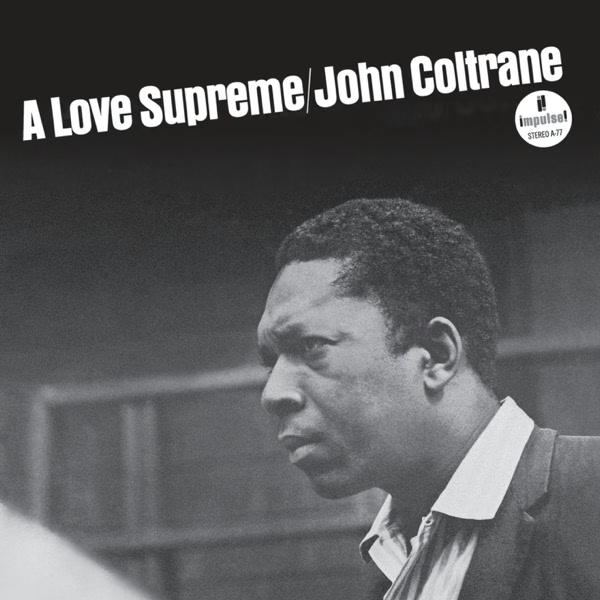
When he found a combination that worked, he played it until it stopped working, then started searching again. The search was the point.
The quartet he assembled in the early sixties -- McCoy Tyner on piano, Jimmy Garrison on bass, Elvin Jones on drums -- was not a band in the conventional sense. It was a mechanism designed to support one kind of inquiry. Tyner stacked chords in fourths, creating harmonic suspensions that never fully resolved. Jones played time as a circular event rather than a linear one. Garrison held the bottom with a single-mindedness that gave the other three room to orbit. And Coltrane, playing soprano saxophone as often as tenor, pushed the melody into territory that had no names. He switched from the hard reeds he had been using to softer ones -- from a nine to a four, by his own account -- because he realized the harder reed was limiting his possibilities and reducing his stamina. The softer reed gave him volubility. He could say more.
He was notorious for his equipment obsession. Fellow saxophonist Wayne Shorter recalled that Coltrane once tried out a brand-new Selmer Mark VI at a club in Manhattan, could not get the sound he wanted, and drove all the way back to Huntington, Long Island -- where he lived -- to retrieve his old saxophone. He kept a collection of mouthpieces and would have them adjusted by specialists, fine sanding the facings, chasing a resonance that existed in his mind's ear. He used different ligatures, different reed brands, different combinations for different sessions. When he found a combination that worked, he played it until it stopped working, then started searching again. The search was the point.
He died on July 17, 1967, of liver cancer, at forty years old. His final recordings, made in the months before his death, were dissonant, abstract, openly searching -- music that had left most listeners behind and entered a territory only he could hear. The posthumous Pulitzer Prize arrived in 2007, forty years after his death. The African Orthodox Church had canonized him as a saint in 1982. Neither honor mattered as much as the work itself.
The verdict is not complicated: Coltrane did not change jazz by being the most talented musician of his generation. He changed it by being the most obsessed. The hours in the corner, the teeth filed to match the mouthpiece, the drive back to Long Island for the old saxophone -- these were not eccentricities. They were the engine. The engine is still running.
Sources: Hotsupper research, Lewis Porter -- John Coltrane: His Life and Music (1999), Down Beat -- April 12, 1962 (Coltrane and Dolphy respond to critics), Down Beat -- September 29, 1960 ("Coltrane on Coltrane"), AllMusic, Wikipedia ---