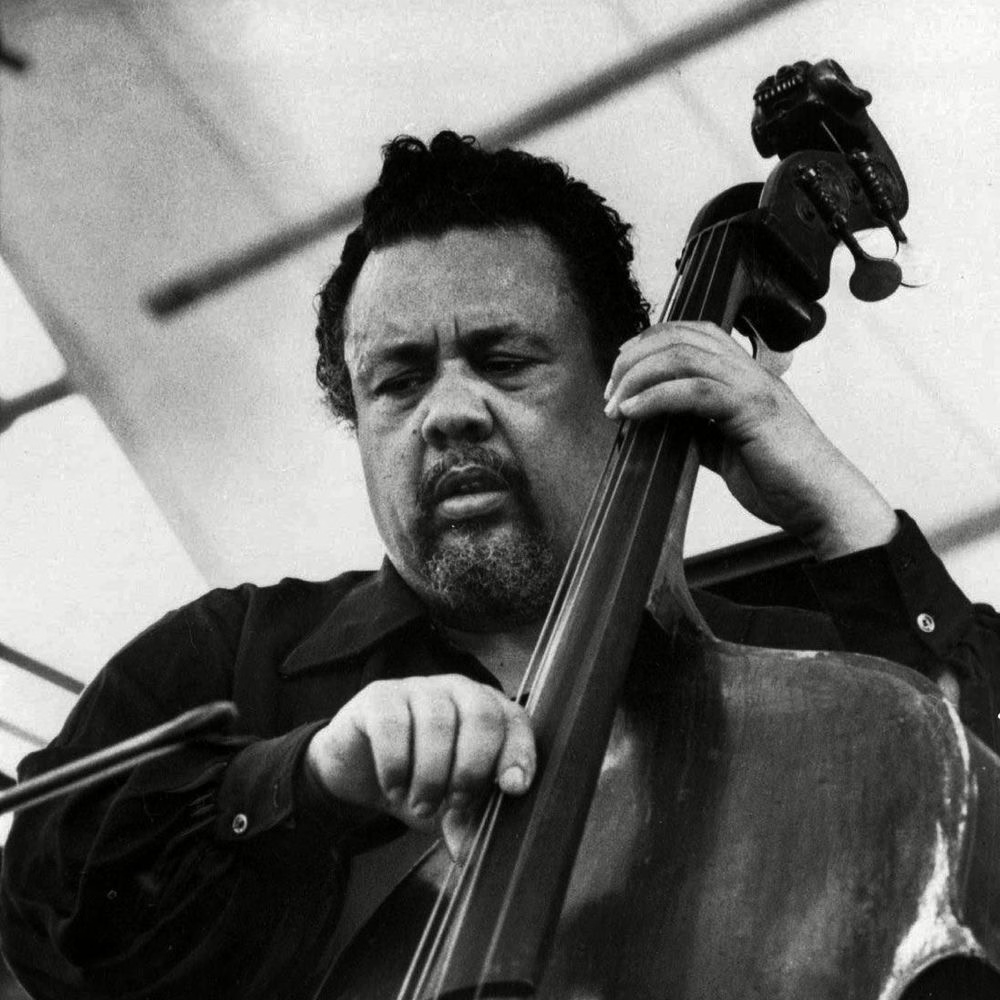
Charles Mingus tracklist updated 08/2026
"Better get it in your soul Better get it in your soul"
-- from Better Git It in Your Soul
He was born on an Army post in Arizona in 1922 and raised in Watts, where two sounds competed for his attention from childhood: the church choir and Duke Ellington on the radio. Both stayed with him. The sacred harmonies and the swing of the big band ran through everything he wrote, and he studied the bass seriously enough to play with the best of his generation, from Louis Armstrong to Charlie Parker. By the mid-fifties he was leading workshops, bands designed as laboratories where the musicians were expected to help build the music, not just play their parts. His composition Pithecanthropus Erectus traced the rise and fall of a prehistoric figure over six movements, ending in a chaos that contemporary critics rejected and later historians recognized as a blueprint.
He was famously hard to work for and hard to please. He fired players mid-song, argued with audiences, and refused to perform in front of segregated crowds, a stand that cost him money and earned him enemies. But the anger was only one side. The same man wrote Mingus Ah Um, an album full of gentle, elegiac tributes to musicians he loved, and The Black Saint and the Sinner Lady, a forty-minute suite he described as a ballet, a novel, and a symphony wrapped in one.

His workshops were experiments in democracy, bands where the written charts were only a starting point and the musicians were expected to bring their own ideas into the music. His autobiography, Beneath the Underdog, published in 1971, told his story without softening any of it, and the music world read it as a confession while musicians heard it as testimony.
He was born on an Army post in Arizona in 1922 and raised in Watts, where two sounds competed for his attention from childhood: the church choir and Duke Ellington on the radio. Both stayed with him. The sacred harmonies and the swing of the big band ran through everything he wrote, and he studied the bass seriously enough to play with the best of his generation, from Louis Armstrong to Charlie Parker. By the mid-fifties he was leading workshops, bands designed as laboratories where the musicians were expected to help build the music, not just play their parts. His composition Pithecanthropus Erectus traced the rise and fall of a prehistoric figure over six movements, ending in a chaos that contemporary critics rejected and later historians recognized as a blueprint.
He was famously hard to work for and hard to please. He fired players mid-song, argued with audiences, and refused to perform in front of segregated crowds, a stand that cost him money and earned him enemies. But the anger was only one side. The same man wrote Mingus Ah Um, an album full of gentle, elegiac tributes to musicians he loved, and The Black Saint and the Sinner Lady, a forty-minute suite he described as a ballet, a novel, and a symphony wrapped in one. His workshops were experiments in democracy, bands where the written charts were only a starting point and the musicians were expected to bring their own ideas into the music. His autobiography, Beneath the Underdog, published in 1971, told his story without softening any of it, and the music world read it as a confession while musicians heard it as testimony.
The last years were hard. A wasting disease took his hands in the late seventies, and he died in 1979 at fifty-six, but he kept composing to the end, humming and whistling his final pieces to assistants who wrote them down. The last works premiered after his death. He left behind hundreds of compositions and a way of playing the bass that turned the instrument from a servant into a leader. Every musician who has ever demanded that jazz tell the truth, with all the rough edges intact, is carrying on the argument he started.
Sources: Hotsupper research, Wikipedia, Charles Mingus (Beneath the Underdog), Krin Gabbard (Better Git It in Your Soul), charlesmingus.com, Wikidata
Charles Mingus was profiled in the documentary, Triumph of the Underdog, in 1998.