This is Emancipation Weekend. On August 1, 1834, the Slavery Abolition Act freed the enslaved across the British Empire, and Black Americans claimed the date as their own too -- a day for freedom marches and freedom songs. The song below is a train that has been running since. The Impressions cut it in Chicago in the winter of 1964, and it is still boarding passengers. Curtis Mayfield wrote it. We will come back to him, because everything comes back to him.
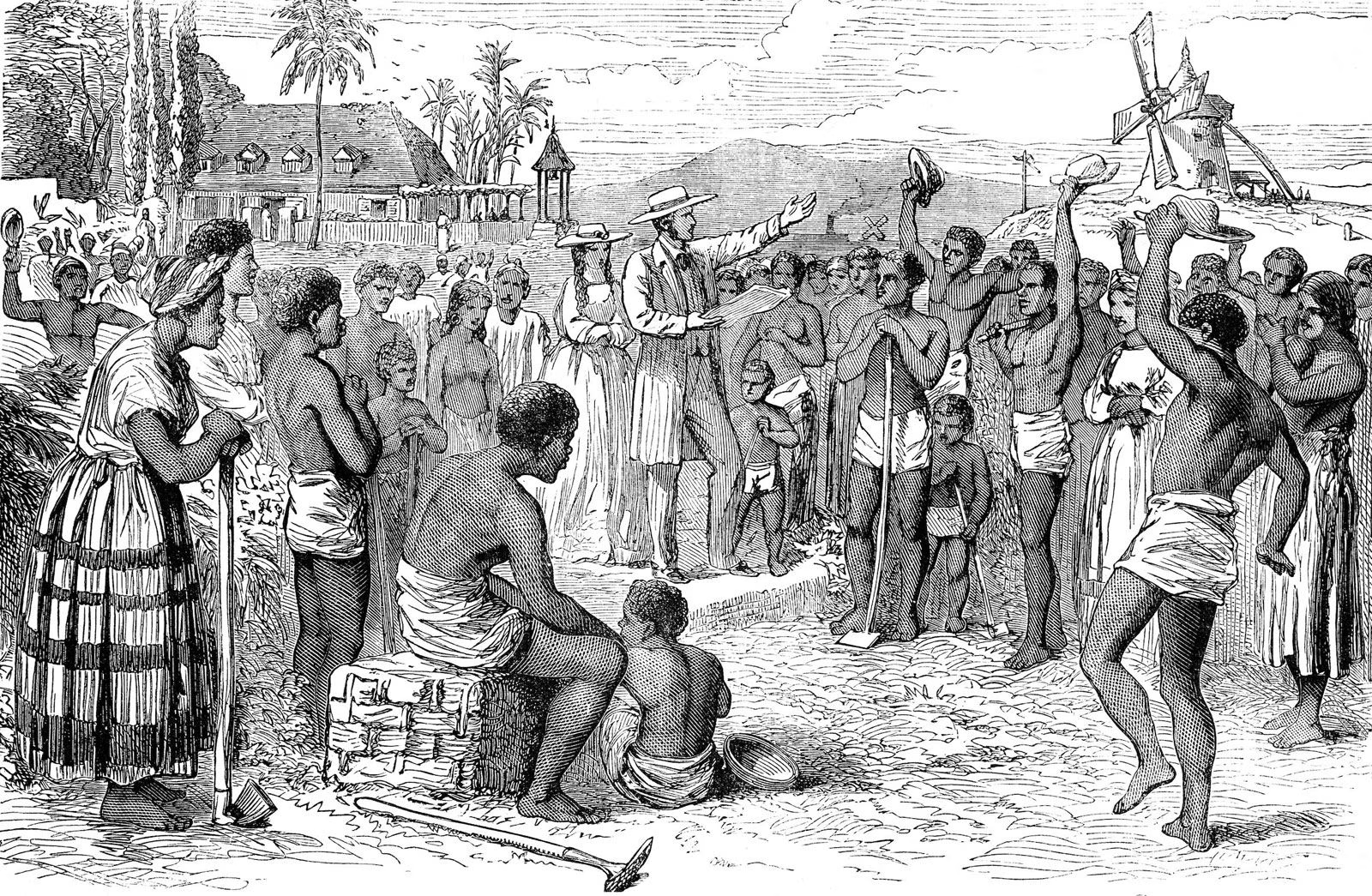
Enslaved people in the British West Indies receive news of their emancipation, following the Slavery Abolition Act of 1833. Public domain.
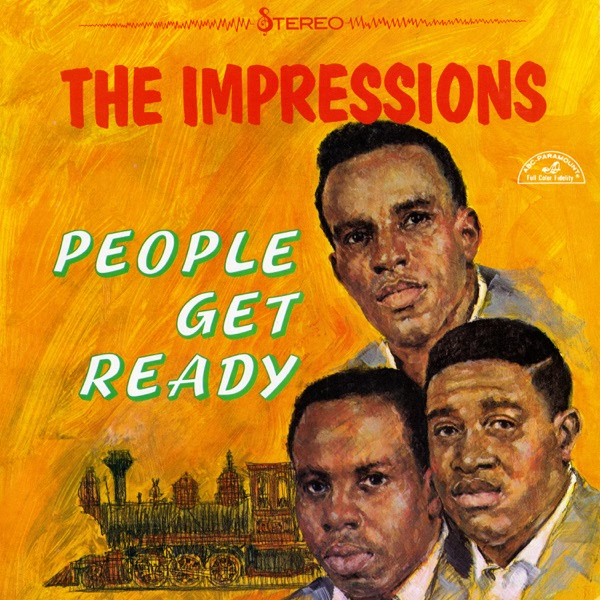
Picture Universal Recording: Mayfield at the lead mic, twenty-two years old, singing in a falsetto that sounds less like a man than like light through a church window. Sam Gooden and Fred Cash wait behind him, pizzicato strings tapping like rain, a glockenspiel rising bright as a struck match. Johnny Pate wrote the chart; Mayfield wrote everything else.
By 1965 it was a gospel song, a train song, and a civil rights anthem all at once -- no contradiction there. It reached number three R&B, number fourteen pop, and gave Mayfield's guitar its first real solo spotlight, a sound he traced back to his grandmother's preaching. He told Terry Gross in 1993 that he thought of his gospel songs as inspirational, not gospel -- he wasn't writing hymns, he was finishing a sentence the hymns had been building toward for three hundred years.
People Get Ready
Listen while you read: People Get Ready | People Get Ready | 1965
The Train Was Always Running
Nineteen sixty-five was the year of Selma, of marchers beaten across the Edmund Pettus Bridge, of the Voting Rights Act fought for and finally won. To be boxed into segregated schools, jobs, and neighborhoods is to be denied the mobility others take for granted, and Black music has always answered that denial with motion -- highways, marches, trains. People Get Ready is the purest statement of that answer ever pressed onto a 45. No baggage. No ticket. No check on your name or your past. Just faith enough to hear the diesels humming, and you're aboard.
The train doesn't run on rails laid in 1965. It runs on rails laid in 1831, when the network carrying enslaved people out of the South took the name Underground Railroad. Harriet Tubman, called Moses, sang Go Down Moses to signal fugitives hidden in the dark, and called out as they crossed into Canada: one more soul safe. Every gospel train that ever rolled through a Black church rides somewhere inside this record -- the church said the soul traveled after death, but the people in the pews had a longer memory than that. Mayfield pulled it all onto the tracks and left the doors open.
Out of context, the song could pass for simple faith -- the train as God's grace, the kingdom's throne at the end of the line. But Martin Luther King Jr. called it the unofficial anthem of the movement, playing it to get people marching and to calm them when the night got long. The middle verse names a hopeless sinner and asks pity for those whose chances grow thinner; in 1965 the sinners weren't hard to name. Mayfield never named them -- the train didn't need to stop for them to know it was leaving without them.
Get On Board
The performance is a conversation, not a solo. Mayfield sings lead in that silken falsetto; Gooden answers underneath him -- a train a-comin'. Cash and Gooden hum, then answer again: you just get on board. Call and response, the oldest structure in Black music, doing theology and politics in the same breath. After the guitar interlude the whole record steps up a key, like the train gathering speed, the doors swinging wider to let more people through.
People get ready, there's a train a-comin' You don't need no baggage, you just get on board All you need is faith to hear the diesels hummin' You don't need no ticket, you just thank the Lord
What Mayfield built with that voice, that guitar, and two friends' harmony was Chicago soul's clearest document -- gospel's blood carried into the pop charts without spilling a drop. AllMusic calls it one of the most beautiful songs of the 1960s. That's not hype, that's description: two minutes and forty seconds, and the record makes an argument most essays can't make in ten pages.
The Gentle Genius
Curtis Mayfield, 1972. Photo: AVRO, CC BY-SA 3.0
Curtis Mayfield was born June 3, 1942, in Chicago, and raised in Cabrini-Green by his mother and the grandmother whose preaching gave him the songs that made his name. Kids called him Smut for being small and dark-skinned; he spent his career turning that shame into shine, one record at a time. He met Jerry Butler in a church choir at fourteen; together they formed the Roosters, who became the Impressions and scored a hit in 1958 before the label spun Butler off solo. Mayfield stayed. In 1961, Gypsy Woman gave the group its own hit, and the door swung open.
What came through that door was a run of records that mapped the movement as it happened -- Keep On Pushing, It's All Right, Amen, then People Get Ready, then We're a Winner, Move On Up. When he scored Superfly in 1972, he flipped the genre inside out, exposing the emptiness of the pusher's life instead of glamorizing it. They called him the Gentle Genius -- the gentleness real, and so was the refusal to look away.
When people praised his role in the movement, Mayfield waved it off. "I'm just an entertainer," he said, and it wasn't false modesty so much as a precise definition of his craft: he wrote songs, and the songs did the work, marching into your head and staying there because they also sounded great on the radio. That was the genius -- a man who absorbed everything from Segovia to Muddy Waters and distilled it into two and a half minutes of light.
On August 13, 1990, a lighting rig fell on him at an outdoor concert in Brooklyn, and Mayfield was paralyzed from the neck down at forty-eight. He kept working anyway -- a verse on a 1992 remake of Let's Do It Again, a final album, New World Order, recorded from his bed in 1996 -- before he died on December 26, 1999, at fifty-seven. The man who wrote the song about boarding the train spent his last years unable to move a limb, and the song kept running the whole time anyway. That's the part worth sitting with -- not as tragedy, but as proof. The train never needed him to walk. It only ever needed him to be ready, and he was, right up to the end.
Everyone Wanted a Seat
Lady Soul (1968)Exodus (1977)
Dozens of artists have recorded this song since; two matter most, each hearing a different verse of the same sermon.
Bob Marley and the Wailers first cut One Love in 1965, the same year the Impressions released this one. In 1977 they re-recorded it as One Love/People Get Ready for Exodus, borrowing four lines from Mayfield and this time crediting him as co-writer. Marley heard in Mayfield's train the same thing he heard in his own Zion -- a promised land reachable through music. The ska of 1965 became the reggae of 1977. Released as a single in 1984, three years after Marley's death, it became one of the biggest hits of his catalog. Mayfield's train, running now on Marley's rhythm.
Aretha Franklin cut her version for Lady Soul, the 1968 album that also carried Chain of Fools and Natural Woman. Where the Impressions sang like people waiting on the platform, Aretha sings like someone already aboard, leaning out the door, calling to the stragglers still running to catch it -- the invitation turned into a confirmation. The train is real, and she's on it.
Rod Stewart and Jeff Beck rode their version to number five on the Mainstream Rock chart in 1985; Bob Dylan recorded it twice; in 2013, soldiers of the 505th Quartermaster Battalion performed it at a Black History Month observance in Okinawa, Japan -- proof the song was still gathering people, oceans and generations from where it started.
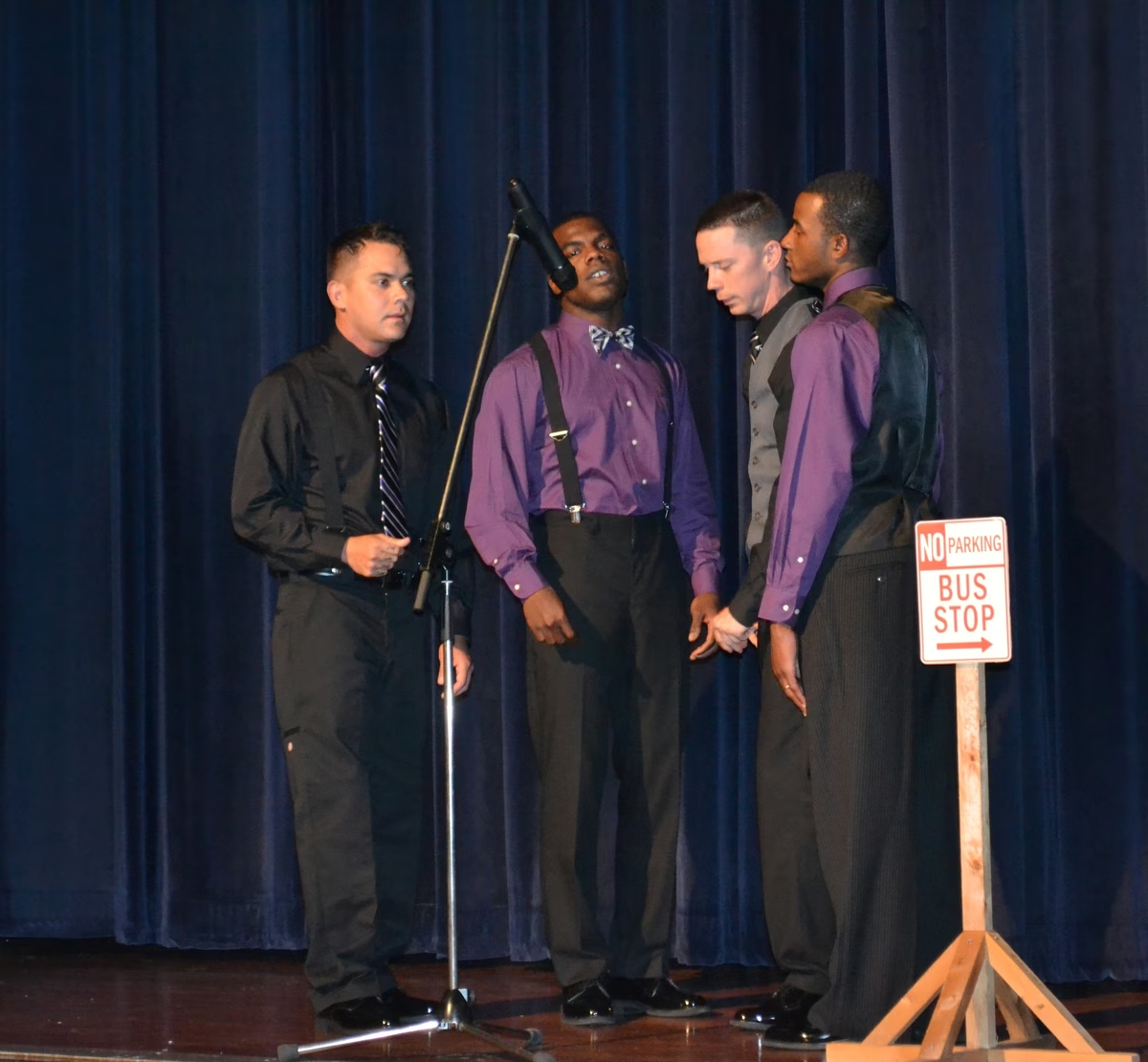
Soldiers of the 505th Quartermaster Battalion perform the song at Kadena, Okinawa, 2013. Photo: US Army (public domain).
The honors have piled up like passengers at a busy station: the Grammy Hall of Fame in 1998, the Rock and Roll Hall of Fame's 500 Songs That Shaped Rock and Roll, regular spots on Rolling Stone's greatest-songs and greatest-guitar-tracks lists. In 2000, twenty songwriters -- Paul McCartney and Brian Wilson among them -- named it one of the ten best songs ever written, for Mojo. In 2015, the Library of Congress added it to the National Recording Registry, tracing its rails back to the Underground Railroad and forward into whatever comes next.
All that grandeur sits a little oddly on a record built from two minutes and forty seconds of humility. That's the song's final trick, and maybe its most generous one: the acclaim is real, and the song remains exactly what it always was -- a quiet invitation, offered in falsetto, over strings that sound like rain. The train has carried Harriet Tubman's fugitives, the Freedom Riders, the marchers on the bridge at Selma, and everyone since who heard the diesels humming and decided to board. The road hasn't gotten any easier, and Mayfield never pretended it would -- but that was never the point. The train doesn't wait for the road to clear. It runs anyway, gathering speed, doors open, asking the same gentle question it's always asked. Are you ready? It's coming. It has always been coming. And there is always room.
Sources: HotSupper research, Wikipedia, AllMusic, Library of Congress National Recording Registry (essay by Brad Erickson), American Songwriter (Rick Moore), Why Evolution Is True (Jerry Coyne), David Hinckley (Medium), NPR Fresh Air (1993).
soulgospel1960scivil-rightsthe-impressions
The Sunday Drop
One song delivered to your inbox every Sunday morning.
Join the readers who start their Sunday with a story they didn't know they needed.
The Sunday Drop
One song. One story. Every Sunday.
No algorithms. No trending sections. Just a song someone loved and the story behind it. Delivered Sunday morning.
✓Check your email to confirm.
Free. No spam. Unsubscribe anytime.
Image Credits
1,449 artist portraits across 5 genres (Rock, Jazz, Soul, Blues, Folk).
1,363 sourced from Wikipedia (Creative Commons / Public Domain), 50 from
Deezer (promotional artwork).
This is Emancipation Weekend. On August 1, 1834, the Slavery Abolition Act freed the enslaved across the British Empire, and Black Americans claimed the date as their own too -- a day for freedom marches and freedom songs. The song below is a train that has been running since. The Impressions cut it in Chicago in the winter of 1964, and it is still boarding passengers. Curtis Mayfield wrote it. We will come back to him, because everything comes back to him.
Enslaved people in the British West Indies receive news of their emancipation, following the Slavery Abolition Act of 1833. Public domain.
Picture Universal Recording: Mayfield at the lead mic, twenty-two years old, singing in a falsetto that sounds less like a man than like light through a church window. Sam Gooden and Fred Cash wait behind him, pizzicato strings tapping like rain, a glockenspiel rising bright as a struck match. Johnny Pate wrote the chart; Mayfield wrote everything else.
By 1965 it was a gospel song, a train song, and a civil rights anthem all at once -- no contradiction there. It reached number three R&B, number fourteen pop, and gave Mayfield's guitar its first real solo spotlight, a sound he traced back to his grandmother's preaching. He told Terry Gross in 1993 that he thought of his gospel songs as inspirational, not gospel -- he wasn't writing hymns, he was finishing a sentence the hymns had been building toward for three hundred years.
People Get Ready
Listen while you read: People Get Ready | People Get Ready | 1965
The Train Was Always Running
Nineteen sixty-five was the year of Selma, of marchers beaten across the Edmund Pettus Bridge, of the Voting Rights Act fought for and finally won. To be boxed into segregated schools, jobs, and neighborhoods is to be denied the mobility others take for granted, and Black music has always answered that denial with motion -- highways, marches, trains. People Get Ready is the purest statement of that answer ever pressed onto a 45. No baggage. No ticket. No check on your name or your past. Just faith enough to hear the diesels humming, and you're aboard.
The train doesn't run on rails laid in 1965. It runs on rails laid in 1831, when the network carrying enslaved people out of the South took the name Underground Railroad. Harriet Tubman, called Moses, sang Go Down Moses to signal fugitives hidden in the dark, and called out as they crossed into Canada: one more soul safe. Every gospel train that ever rolled through a Black church rides somewhere inside this record -- the church said the soul traveled after death, but the people in the pews had a longer memory than that. Mayfield pulled it all onto the tracks and left the doors open.
Out of context, the song could pass for simple faith -- the train as God's grace, the kingdom's throne at the end of the line. But Martin Luther King Jr. called it the unofficial anthem of the movement, playing it to get people marching and to calm them when the night got long. The middle verse names a hopeless sinner and asks pity for those whose chances grow thinner; in 1965 the sinners weren't hard to name. Mayfield never named them -- the train didn't need to stop for them to know it was leaving without them.
Get On Board
The performance is a conversation, not a solo. Mayfield sings lead in that silken falsetto; Gooden answers underneath him -- a train a-comin'. Cash and Gooden hum, then answer again: you just get on board. Call and response, the oldest structure in Black music, doing theology and politics in the same breath. After the guitar interlude the whole record steps up a key, like the train gathering speed, the doors swinging wider to let more people through.
People get ready, there's a train a-comin' You don't need no baggage, you just get on board All you need is faith to hear the diesels hummin' You don't need no ticket, you just thank the Lord
What Mayfield built with that voice, that guitar, and two friends' harmony was Chicago soul's clearest document -- gospel's blood carried into the pop charts without spilling a drop. AllMusic calls it one of the most beautiful songs of the 1960s. That's not hype, that's description: two minutes and forty seconds, and the record makes an argument most essays can't make in ten pages.
The Gentle Genius
Curtis Mayfield, 1972. Photo: AVRO, CC BY-SA 3.0
Curtis Mayfield was born June 3, 1942, in Chicago, and raised in Cabrini-Green by his mother and the grandmother whose preaching gave him the songs that made his name. Kids called him Smut for being small and dark-skinned; he spent his career turning that shame into shine, one record at a time. He met Jerry Butler in a church choir at fourteen; together they formed the Roosters, who became the Impressions and scored a hit in 1958 before the label spun Butler off solo. Mayfield stayed. In 1961, Gypsy Woman gave the group its own hit, and the door swung open.
What came through that door was a run of records that mapped the movement as it happened -- Keep On Pushing, It's All Right, Amen, then People Get Ready, then We're a Winner, Move On Up. When he scored Superfly in 1972, he flipped the genre inside out, exposing the emptiness of the pusher's life instead of glamorizing it. They called him the Gentle Genius -- the gentleness real, and so was the refusal to look away.
When people praised his role in the movement, Mayfield waved it off. "I'm just an entertainer," he said, and it wasn't false modesty so much as a precise definition of his craft: he wrote songs, and the songs did the work, marching into your head and staying there because they also sounded great on the radio. That was the genius -- a man who absorbed everything from Segovia to Muddy Waters and distilled it into two and a half minutes of light.
On August 13, 1990, a lighting rig fell on him at an outdoor concert in Brooklyn, and Mayfield was paralyzed from the neck down at forty-eight. He kept working anyway -- a verse on a 1992 remake of Let's Do It Again, a final album, New World Order, recorded from his bed in 1996 -- before he died on December 26, 1999, at fifty-seven. The man who wrote the song about boarding the train spent his last years unable to move a limb, and the song kept running the whole time anyway. That's the part worth sitting with -- not as tragedy, but as proof. The train never needed him to walk. It only ever needed him to be ready, and he was, right up to the end.
Everyone Wanted a Seat
Lady Soul (1968)Exodus (1977)
Dozens of artists have recorded this song since; two matter most, each hearing a different verse of the same sermon.
Bob Marley and the Wailers first cut One Love in 1965, the same year the Impressions released this one. In 1977 they re-recorded it as One Love/People Get Ready for Exodus, borrowing four lines from Mayfield and this time crediting him as co-writer. Marley heard in Mayfield's train the same thing he heard in his own Zion -- a promised land reachable through music. The ska of 1965 became the reggae of 1977. Released as a single in 1984, three years after Marley's death, it became one of the biggest hits of his catalog. Mayfield's train, running now on Marley's rhythm.
Aretha Franklin cut her version for Lady Soul, the 1968 album that also carried Chain of Fools and Natural Woman. Where the Impressions sang like people waiting on the platform, Aretha sings like someone already aboard, leaning out the door, calling to the stragglers still running to catch it -- the invitation turned into a confirmation. The train is real, and she's on it.
Rod Stewart and Jeff Beck rode their version to number five on the Mainstream Rock chart in 1985; Bob Dylan recorded it twice; in 2013, soldiers of the 505th Quartermaster Battalion performed it at a Black History Month observance in Okinawa, Japan -- proof the song was still gathering people, oceans and generations from where it started.
Soldiers of the 505th Quartermaster Battalion perform the song at Kadena, Okinawa, 2013. Photo: US Army (public domain).
The honors have piled up like passengers at a busy station: the Grammy Hall of Fame in 1998, the Rock and Roll Hall of Fame's 500 Songs That Shaped Rock and Roll, regular spots on Rolling Stone's greatest-songs and greatest-guitar-tracks lists. In 2000, twenty songwriters -- Paul McCartney and Brian Wilson among them -- named it one of the ten best songs ever written, for Mojo. In 2015, the Library of Congress added it to the National Recording Registry, tracing its rails back to the Underground Railroad and forward into whatever comes next.
All that grandeur sits a little oddly on a record built from two minutes and forty seconds of humility. That's the song's final trick, and maybe its most generous one: the acclaim is real, and the song remains exactly what it always was -- a quiet invitation, offered in falsetto, over strings that sound like rain. The train has carried Harriet Tubman's fugitives, the Freedom Riders, the marchers on the bridge at Selma, and everyone since who heard the diesels humming and decided to board. The road hasn't gotten any easier, and Mayfield never pretended it would -- but that was never the point. The train doesn't wait for the road to clear. It runs anyway, gathering speed, doors open, asking the same gentle question it's always asked. Are you ready? It's coming. It has always been coming. And there is always room.
Sources: HotSupper research, Wikipedia, AllMusic, Library of Congress National Recording Registry (essay by Brad Erickson), American Songwriter (Rick Moore), Why Evolution Is True (Jerry Coyne), David Hinckley (Medium), NPR Fresh Air (1993).