Minnie Riperton sat at the microphone in Ter Mar Studios, Chicago, November 1969, fifty feet of orchestral tape rolling behind her. Charles Stepney had assembled strings, woodwinds, a rhythm section with Maurice White of the Earth, Wind & Fire constellation on drums and Ramsey Lewis himself at the piano. She was twenty-two. She had already sung backup for Muddy Waters in the same building, fronted a psychedelic soul collective called Rotary Connection, and studied opera long enough to know what a coloratura soprano could do that a regular one could not. What she wanted from this session was a sound like Dionne Warwick meeting Burt Bacharach -- something with architecture, something that felt like walking through a conservatory. The song was called "Les Fleurs." We will come back to her.
"Les Fleurs" -- Minnie Riperton (1970)
The Song That Didn't Know It Was Waiting
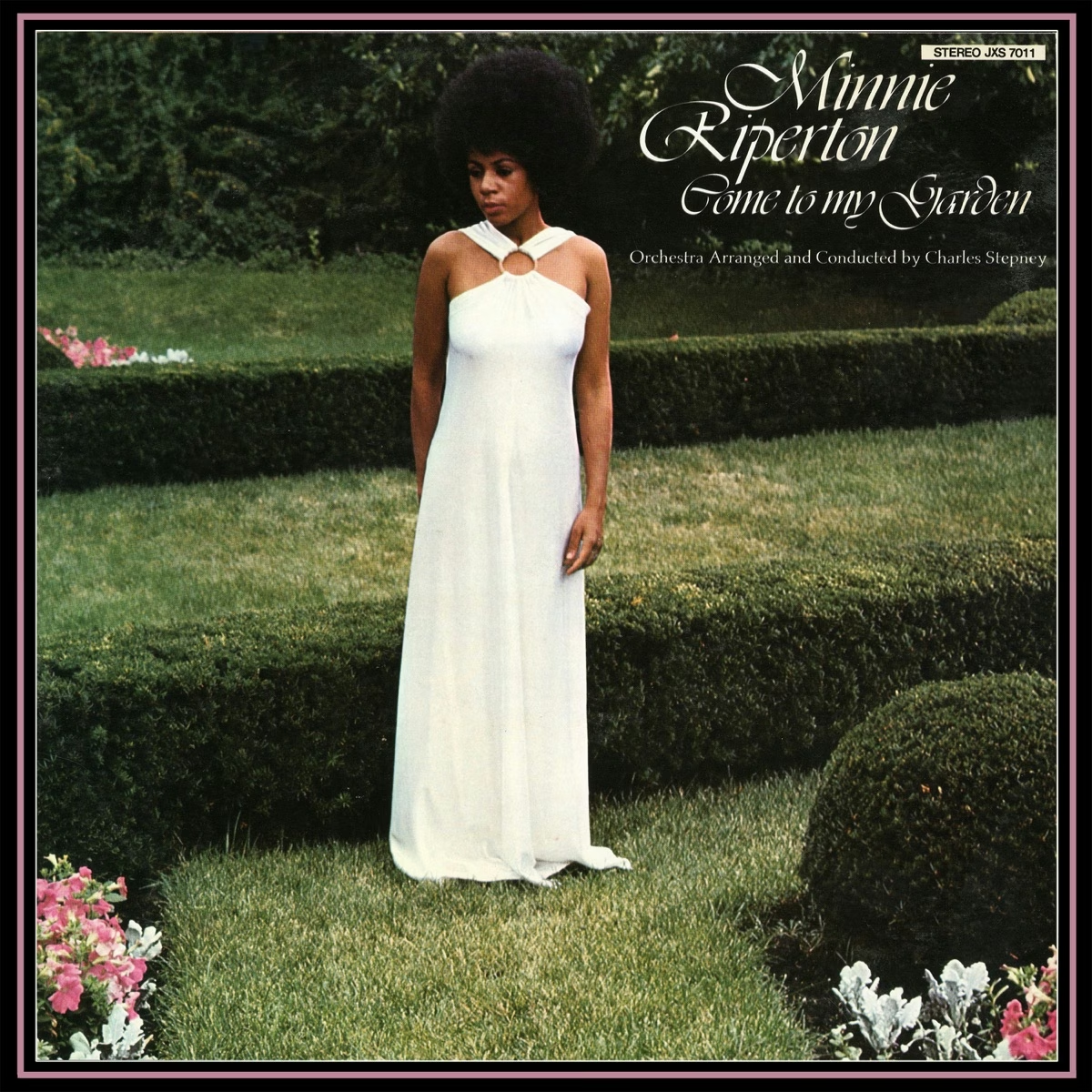
"Les Fleurs" opens Come to My Garden like a curtain parting on a greenhouse nobody knew existed. The first few seconds are all atmosphere -- a breath, a string swell, something liturgical -- before Riperton's voice enters not as a lead vocal but as another instrument in the arrangement. She sings from inside a flower's body. "Will somebody wear me to the fair?" she asks, and the question lands not as whimsy but as theology. The flower has been born for a purpose: to spread love, joy, faith, and hope to people forlorn. Inside every man, she sings, lives the seed of a flower. If he looks within, he finds beauty and power.
Stepney's arrangement moves through the song like someone turning a prism. The verses are chamber-music intimate -- voice, strings, a bassline that breathes -- and then the chorus opens into something almost gospel-scaled. "Ring all the bells, sing and tell the people / Everywhere that the flower has come." It is a song about renewal, about the thing that grows back after winter, and Stepney understood that you don't explain that feeling. You build a sound big enough to contain it. The track runs three minutes and eighteen seconds. It takes less time than a shower. It has lasted longer than most careers.
Written by Stepney and Richard Rudolph, the man Riperton had married in August of that same year, "Les Fleurs" is the rare case where the credits tell as much of the story as the lyrics. Stepney was her collaborator from the Rotary Connection days, the architect who understood that her voice was not a lead instrument in the conventional sense -- it was a texture, a color, a fourth dimension the arrangement could move through. Rudolph was her partner, the person who would outlive her by forty-five years and spend much of that time protecting her legacy. The song exists at the intersection of those two relationships, and you can hear both of them in the arrangement: the producer who knew what to build around her, and the husband who knew what she was trying to say.
From Bronzeville to the Mothership
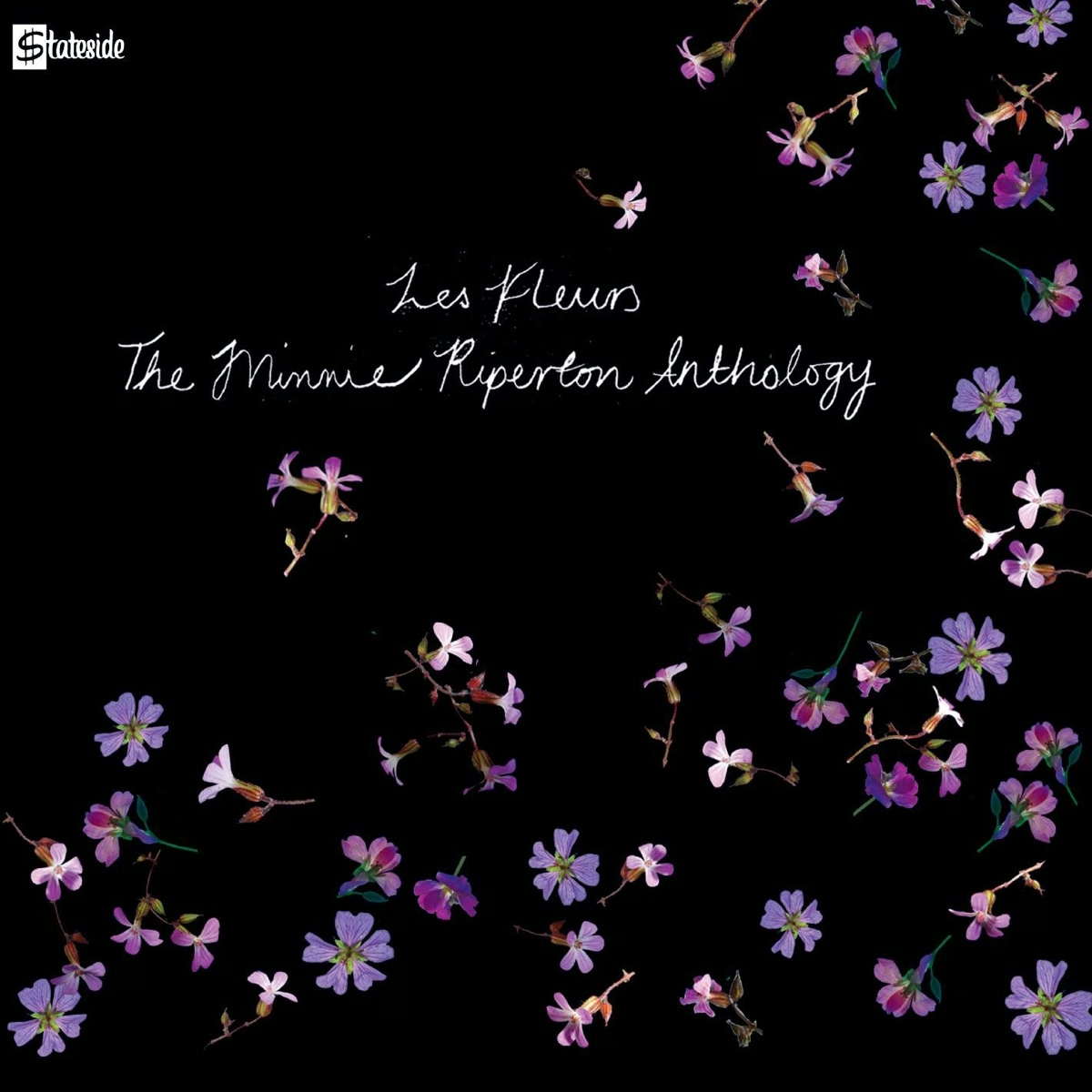
Minnie Riperton grew up in Chicago's Bronzeville neighborhood, the youngest of eight children, studying ballet and modern dance before her parents noticed she had a voice that could hold a room. She trained under Marion Jeffery, an opera teacher who drilled her on breathing, phrasing, and diction with the kind of discipline that would later make her sound effortless doing things no one else could do. Jeffery wanted her at the Lyric Opera. Riperton, at fifteen, wanted to sing with a girl group called the Gems, and the Gems led to session work, and session work led to Chess Records, where she walked into a building that had engineered the sound of postwar American music.
At Chess, she was the front-of-house girl -- the person who sang backup for Etta James, Muddy Waters, Chuck Berry, Fontella Bass, and Ramsey Lewis while absorbing how records were actually made. This was not a music school. It was a music factory, and she learned by proximity. Then Marshall Chess, the founder's son, decided to build something strange. Rotary Connection was a psychedelic soul collective, part rock band, part laboratory, fronted by Riperton and arranged by a classically trained pianist named Charles Stepney. They recorded six albums between 1967 and 1971, none of them hits, all of them weird in ways that would take forty years to sound contemporary.
Stepney and Riperton developed a creative shorthand during those years that carried directly into Come to My Garden. The heavy rock guitar that Rotary Connection leaned on is gone from her solo debut, replaced by woodwinds, string sections, and the kind of orchestration that Stepney learned studying Ravel and Debussy alongside the Staple Singers and Curtis Mayfield. The album sold almost nothing. It peaked at number 160 on the Billboard 200 in 1974, four years after its release, riding the coattails of a hit that would come later. But the people who heard it understood that something had happened in Ter Mar Studios that November. The original master tapes were eventually lost. Every CD release since has been mastered from vinyl, which is either a tragedy or a metaphor, depending on how you feel about impermanence.
After Come to My Garden failed to sell, Riperton retreated to Gainesville, Florida, where she raised her two children and assumed a kind of semi-retirement that suited the life she had chosen. A college intern from Epic Records heard a demo of "Seeing You This Way," brought it to his A&R department, and pulled her back into the business. The album she made, Perfect Angel (1974), was a folk-soul record of such specific sweetness that it should not have worked at all. What made it work was the man behind the board, listed in the credits as "El Toro Negro" -- Spanish for "the black bull" -- a pseudonym Stevie Wonder used because his Motown contract did not leave room for producing records on a rival label.
The origin of the alias is the kind of inside joke that gets argued about in comment sections decades later. Was it a reference to Wonder's astrological sign, Taurus the bull? Or was it Richard Rudolph riffing on Black Bull Music, Wonder's publishing company, plus a lyric from "Superwoman" off Music of My Mind? The answer is probably both, which is how the best inside jokes work -- layered enough that the people in the room could each claim a different corner of it. What matters is the disguise itself, which was never much of a disguise. Once "Lovin' You" broke as a global number one in April 1975, nobody believed Stevie Wonder was not involved. Riperton herself downplayed his role in the press, telling Rolling Stone she would not even call it producing -- "he just acted as the overseer" -- partly because if he took visible credit, every artist with a demo tape would be lobbying him for the same treatment.
The Pseudonym and the Lullaby

"Lovin' You" started as a lullaby. Rudolph was playing a melody on guitar, Riperton improvised lyrics to distract baby Maya, and the song grew from a moment of domestic improvisation into a global hit that sold over a million copies. Maya's name is audible at the end of the album cut -- "Maya, Maya, Maya" -- a piece of family history embedded in the most famous song of her mother's career. It is also, in retrospect, the kind of detail that makes the rest of the story harder to read. The woman who sang "Lovin' You" to her daughter did not live to see Maya become one of the most gifted comedic actors of her generation. She died at thirty-one, five years after that song topped the charts.
Wonder reprised the El Toro Negro credit once more, years later, on a track from Riperton's posthumous final album Minnie (1980). The song was "Lover & Friend," recorded not long before she died. The same alias that had been a playful wink on Perfect Angel could not avoid carrying a different emotional weight the second time around. The disguise that had once been a workaround for industry politics now felt like a signature from someone who had already said goodbye.
The Flower in the Dark
Riperton was diagnosed with breast cancer in January 1976. The cancer had already spread to her lymphatic system. She was given six months to live. She lived three more years, continued recording and touring, underwent a radical mastectomy, and became one of the first public figures in the Black community to speak openly about the disease. She served as national spokeswoman for the American Cancer Society in 1978 and 1979. President Jimmy Carter gave her the organization's Courage Award at the White House in 1977. She was thirty when she received it. She died eighteen months later, on July 12, 1979, in her husband's arms, listening to a recording Stevie Wonder had made for her.
The funeral was attended by more than five hundred people. Her epitaph reads: "Lovin' you is easy 'cause you're beautiful." She is buried in Westwood Village Memorial Park in Los Angeles, not far from the Warner Bros. lot where Maya would later build a career making audiences laugh. Stevie Wonder paid tribute to her on Soul Train that September. The documentary series Unsung devoted an episode to her in 2009. Every few years, another generation discovers her voice through a movie soundtrack, which is how "Les Fleurs" has spent the last decade living a second life.
The Second Life
In 2014, Paul Thomas Anderson -- who is married to Maya Rudolph -- placed "Les Fleurs" in Inherent Vice, his fog-drift adaptation of Thomas Pynchon's novel. The song floated through the film's psychedelic California atmosphere like something that had always been there, and for the first time in decades, people who had never heard of Minnie Riperton asked what it was. Five years later, Jordan Peele used the same track to close Us, cueing it over the film's twist-ending flashback to the Hands Across America demonstration. In that context, the flower Riperton had sung about carried a different meaning -- renewal after violence, the thing that grows back through concrete. The song had been out of print and out of mind for nearly fifty years. Peele's film introduced it to a generation raised on streaming, and the platform numbers climbed like a chart release from a different era.
"Les Fleurs" has since appeared in Atlanta, Them, Gaslit, and Back to Black, the Amy Winehouse biopic. British group 4hero covered it on their 2001 album Creating Patterns, and the Orb sampled it on their landmark 1991 single "
Sources: HotSupper research, Wikipedia, Los Angeles Times, uDiscoverMusic, Atwood Magazine.