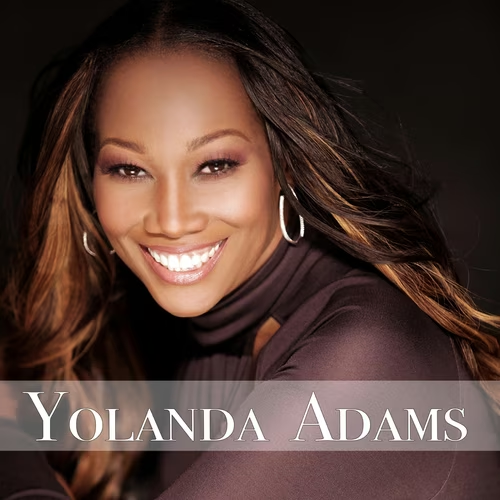
Yolanda Adams tracklist updated 08/2026
"Open my heart, I want you to see
Everything that I'm feeling"
-- from Open My Heart
The path to that album was not straight. Gospel in the 1990s was a closed economy -- church radio, church retail, church touring. Crossing over meant accusations of abandoning the message. Yolanda Adams handled the tension by refusing to choose. Mountain High... Valley Low included collaborations with producers like Jimmy Jam and Terry Lewis, whose resume ran through Janet Jackson and Boyz II Men, and the production was glossy, radio-ready, unmistakably pop. But the lyrics never wavered. "Open My Heart" was a love song addressed to God, not a romantic partner, and it climbed the R&B charts without pretending to be secular. The album won her a Grammy, the first of four, and opened a door that other gospel artists walked through behind her.
What Yolanda Adams did with that platform matters because she expanded the definition of what a gospel artist could be. She hosted a nationally syndicated morning show, The Yolanda Adams Morning Show, broadcast on urban radio stations across America, where she played a mix of gospel, R&B, and inspirational music that did not fit any single format's expectations. She acted. She wrote.
She became the voice that radio programmers called when they needed something that could play in a church and in a crossover format without apologizing. Her 2005 album Day by Day featured Mary Mary and Lil' Mo, and her 2007 live album What a Wonderful Time captured what she does best -- the long build, the spontaneous explosion of praise, the congregation on their feet.
The path to that album was not straight. Gospel in the 1990s was a closed economy -- church radio, church retail, church touring. Crossing over meant accusations of abandoning the message. Yolanda Adams handled the tension by refusing to choose. Mountain High... Valley Low included collaborations with producers like Jimmy Jam and Terry Lewis, whose resume ran through Janet Jackson and Boyz II Men, and the production was glossy, radio-ready, unmistakably pop. But the lyrics never wavered. "Open My Heart" was a love song addressed to God, not a romantic partner, and it climbed the R&B charts without pretending to be secular. The album won her a Grammy, the first of four, and opened a door that other gospel artists walked through behind her.
What Yolanda Adams did with that platform matters because she expanded the definition of what a gospel artist could be. She hosted a nationally syndicated morning show, The Yolanda Adams Morning Show, broadcast on urban radio stations across America, where she played a mix of gospel, R&B, and inspirational music that did not fit any single format's expectations. She acted. She wrote. She became the voice that radio programmers called when they needed something that could play in a church and in a crossover format without apologizing. Her 2005 album Day by Day featured Mary Mary and Lil' Mo, and her 2007 live album What a Wonderful Time captured what she does best -- the long build, the spontaneous explosion of praise, the congregation on their feet.
The voice remains the center. Yolanda Adams is often called the "Queen of Contemporary Gospel," but the title undersells what she actually did. She took the gospel quartet tradition and the Pentecostal altar call and the radio-friendly production of 1990s R&B and made them occupy the same space without one overriding the other. She proved that a woman from Houston who started in a classroom could outsell most secular R&B acts while singing explicitly about faith, and that the audience for that voice was not limited to Sunday morning. The room she opened is still open.
Yolanda Adams was profiled in the documentary, The Yolanda Adams Story, in 2022.