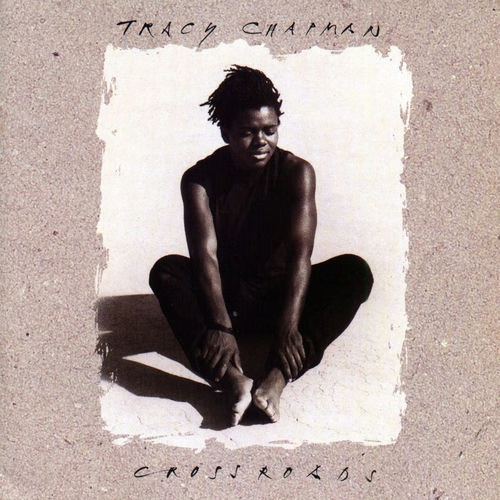
Tracy Chapman
1964 –
One Voice, One Guitar, One Generation Changed
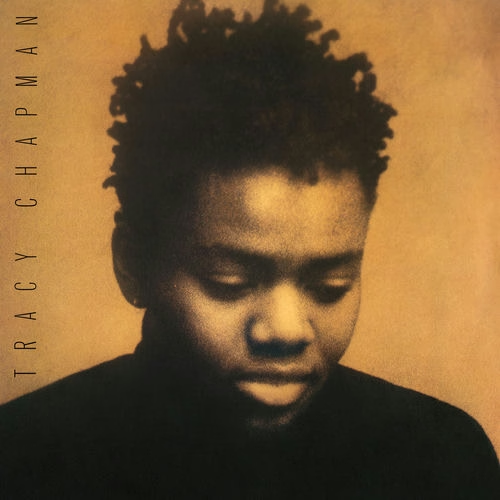
She walked onto the stage at Wembley Stadium in 1988 to fill time because a superstar's equipment had failed, and she sang one song that rewired the room. The song was Fast Car, and the woman was Tracy Chapman, a folk singer from Cleveland who had spent years playing for small crowds and busking on the street. The stadium, built for spectacle, went silent for a voice and an acoustic guitar.
01 Fast Car
02 Talkin' Bout a Revolution
03 Baby Can I Hold You
04 Across the Lines
B1 Sing for You
B2 For My Lover
B3 Why?

Tracy Chapman tracklist updated 08/2026

The album that song came from sold millions in the weeks that followed, and a career built on quiet observation suddenly belonged to the world.

"You gotta make a decision You leave tonight or live and die this way"

-- from Fast Car

She was born in 1964 and grew up in a working-class household where money was scarce and music was the escape hatch. She learned guitar as a teenager, wrote her first songs young, and found her way to Tufts University, where a fellow student helped her land a record deal. Her self-titled debut arrived in 1988 fully formed: an acoustic guitar, a deep alto, and songs about the people who usually do not make it onto the radio. Talkin' Bout a Revolution, written when she was sixteen and thinking about how slowly change comes, Baby Can I Hold You, Fast Car: the songs refused to raise their voices while making their points impossible to miss.

The Wembley appearance turned her into a star overnight, and the Grammys confirmed it, three awards in a single night including Best New Artist. The album also made her the first act to top both the UK and US charts with a debut in years, and she capped the year on the Amnesty International Human Rights Now! tour, sharing world stages with Bruce Springsteen and Sting. What followed was a career built on her own terms. She released albums when she wanted, toured when she wanted, and kept her private life out of the press, a choice that some read as aloof and many more read as integrity.
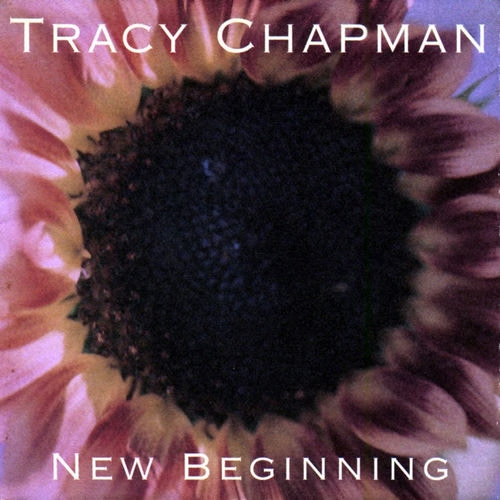
New Beginning (1995)

When she returned to the charts, it was with Give Me One Reason, a slow blues that became her biggest hit and won a Grammy for Best Rock Song. The acoustic intimacy never left her, even on the largest stages in the world.

She was born in 1964 and grew up in a working-class household where money was scarce and music was the escape hatch. She learned guitar as a teenager, wrote her first songs young, and found her way to Tufts University, where a fellow student helped her land a record deal. Her self-titled debut arrived in 1988 fully formed: an acoustic guitar, a deep alto, and songs about the people who usually do not make it onto the radio. Talkin' Bout a Revolution, written when she was sixteen and thinking about how slowly change comes, Baby Can I Hold You, Fast Car: the songs refused to raise their voices while making their points impossible to miss.

The Wembley appearance turned her into a star overnight, and the Grammys confirmed it, three awards in a single night including Best New Artist. The album also made her the first act to top both the UK and US charts with a debut in years, and she capped the year on the Amnesty International Human Rights Now! tour, sharing world stages with Bruce Springsteen and Sting. What followed was a career built on her own terms. She released albums when she wanted, toured when she wanted, and kept her private life out of the press, a choice that some read as aloof and many more read as integrity. When she returned to the charts, it was with Give Me One Reason, a slow blues that became her biggest hit and won a Grammy for Best Rock Song. The acoustic intimacy never left her, even on the largest stages in the world.

Her songs have crossed genres and generations. When Luke Combs covered Fast Car in 2023, it made Chapman the first Black woman to win Song of the Year at the Country Music Association Awards, proof that the universality she wrote about had never faded. She built her name on observation, not noise, and the name has held. She made poverty visible, dignity audible, and the acoustic guitar dangerous again. The quiet revolutionary is still out there, singing songs that sound like they were written by someone who knows exactly what she is talking about.

Sources: Hotsupper research, Wikipedia, Britannica, CBC Radio (2015 interview), Wikidata

Image Credits

1,449 artist portraits across 5 genres (Rock, Jazz, Soul, Blues, Folk). 1,363 sourced from Wikipedia (Creative Commons / Public Domain), 50 from Deezer (promotional artwork).

Full attribution breakdown →

Tracy Chapman

1964 –
One Voice, One Guitar, One Generation Changed
She walked onto the stage at Wembley Stadium in 1988 to fill time because a superstar's equipment had failed, and she sang one song that rewired the room. The song was Fast Car, and the woman was Tracy Chapman, a folk singer from Cleveland who had spent years playing for small crowds and busking on the street. The stadium, built for spectacle, went silent for a voice and an acoustic guitar.
01 Fast Car
02 Talkin' Bout a Revolution
03 Baby Can I Hold You
04 Across the Lines
B1 Sing for You
B2 For My Lover
B3 Why?

Tracy Chapman tracklist updated 08/2026

The album that song came from sold millions in the weeks that followed, and a career built on quiet observation suddenly belonged to the world.

"You gotta make a decision You leave tonight or live and die this way"

-- from Fast Car

She was born in 1964 and grew up in a working-class household where money was scarce and music was the escape hatch. She learned guitar as a teenager, wrote her first songs young, and found her way to Tufts University, where a fellow student helped her land a record deal. Her self-titled debut arrived in 1988 fully formed: an acoustic guitar, a deep alto, and songs about the people who usually do not make it onto the radio. Talkin' Bout a Revolution, written when she was sixteen and thinking about how slowly change comes, Baby Can I Hold You, Fast Car: the songs refused to raise their voices while making their points impossible to miss.

The Wembley appearance turned her into a star overnight, and the Grammys confirmed it, three awards in a single night including Best New Artist. The album also made her the first act to top both the UK and US charts with a debut in years, and she capped the year on the Amnesty International Human Rights Now! tour, sharing world stages with Bruce Springsteen and Sting. What followed was a career built on her own terms. She released albums when she wanted, toured when she wanted, and kept her private life out of the press, a choice that some read as aloof and many more read as integrity. When she returned to the charts, it was with Give Me One Reason, a slow blues that became her biggest hit and won a Grammy for Best Rock Song. The acoustic intimacy never left her, even on the largest stages in the world.

Her songs have crossed genres and generations. When Luke Combs covered Fast Car in 2023, it made Chapman the first Black woman to win Song of the Year at the Country Music Association Awards, proof that the universality she wrote about had never faded. She built her name on observation, not noise, and the name has held. She made poverty visible, dignity audible, and the acoustic guitar dangerous again. The quiet revolutionary is still out there, singing songs that sound like they were written by someone who knows exactly what she is talking about.

Sources: Hotsupper research, Wikipedia, Britannica, CBC Radio (2015 interview), Wikidata
folksoulrock
The Sunday Drop
One song. One story. Every Sunday.

No algorithms. No trending sections. Just a song someone loved and the story behind it. Delivered Sunday morning.

Free. No spam. Unsubscribe anytime.

Image Credits

1,449 artist portraits across 5 genres (Rock, Jazz, Soul, Blues, Folk). 1,363 sourced from Wikipedia (Creative Commons / Public Domain), 50 from Deezer (promotional artwork).

Full attribution breakdown →

0:00
0:00
The Sunday Drop Song. Story. Sundays.
Click any song to hear it in full or in part.