George Clinton
1941 –
Dr. Funkenstein

Born in Kannapolis, North Carolina in 1941, raised in New Jersey by a family that could not afford much but gave him a jukebox. George Clinton started in a doo-wop group called the Parliaments, singing harmonies in a barbershop in Plainfield, and ended up commanding the largest, strangest, most influential funk empire the world has ever seen. Working with Bootsy Collins and Sly Stone, he built a universe around it, complete with spaceships, superheroes, afrofuturist politicians, and a whole taxonomy of grooves.

0:30
0:30
0:30
0:30

James Brown invented funk. George Clinton built a universe around it.

The 1960s music industry was not ready for a Black artist who wanted to be Frank Zappa and James Brown at the same time. Clinton walked into a moment when Motown had polished Black music to a high gloss and Stax had ground it down to grit, and he decided to do neither. He took the Parliaments, split them into Parliament and Funkadelic, signed conflicting contracts with different labels, and spent the next decade untangling the legal mess while simultaneously creating some of the most vital music of the century. The cost was chaos: lawsuits, debt, drug addiction in the ranks, and a business structure that made no sense to anyone outside Clinton's head. But that chaos was also the engine. You cannot make orderly music from a orderly life. The P-Funk sound needed the chaos to breathe.

George Clinton interview 1990

"Atomic Dog 0:30" from 1982 is the late-era masterpiece, a track that Clinton recorded after the Parliament-Funkadelic machinery had mostly ground to a halt. It is minimal and maximal at the same time. That bassline is a single note repeated into infinity. The dog-bark samples, the call-and-response, the way Clinton half-sings half-preaches "why must I be like that? why must I chase the cat?" -- it is absurd and profound and somehow the funkiest thing ever committed to tape.

Computer Games (1982)

The song did not need a chord change. It did not need a bridge. It needed the pocket, and the pocket was infinite. "Atomic Dog" became one of the most sampled records in hip-hop history because it proved that funk could strip down to its skeleton and still move whole crowds.

Clinton is still alive as of this writing, which means the story is not over. He has been inducted into the Rock and Roll Hall of Fame, sampled by everyone from De La Soul to Snoop Dogg, and recognized as maybe the most radical mind in Black popular music. But the real legacy is in the permission he gave. He showed that Black musicians could be weird, could be cosmic, could be funny, could be intellectual without being pretentious, and could build a world that fans could live in. Parliament-Funkadelic was not a band. It was a republic. And George Clinton was its founding father, still laughing, still funky, still atomic.
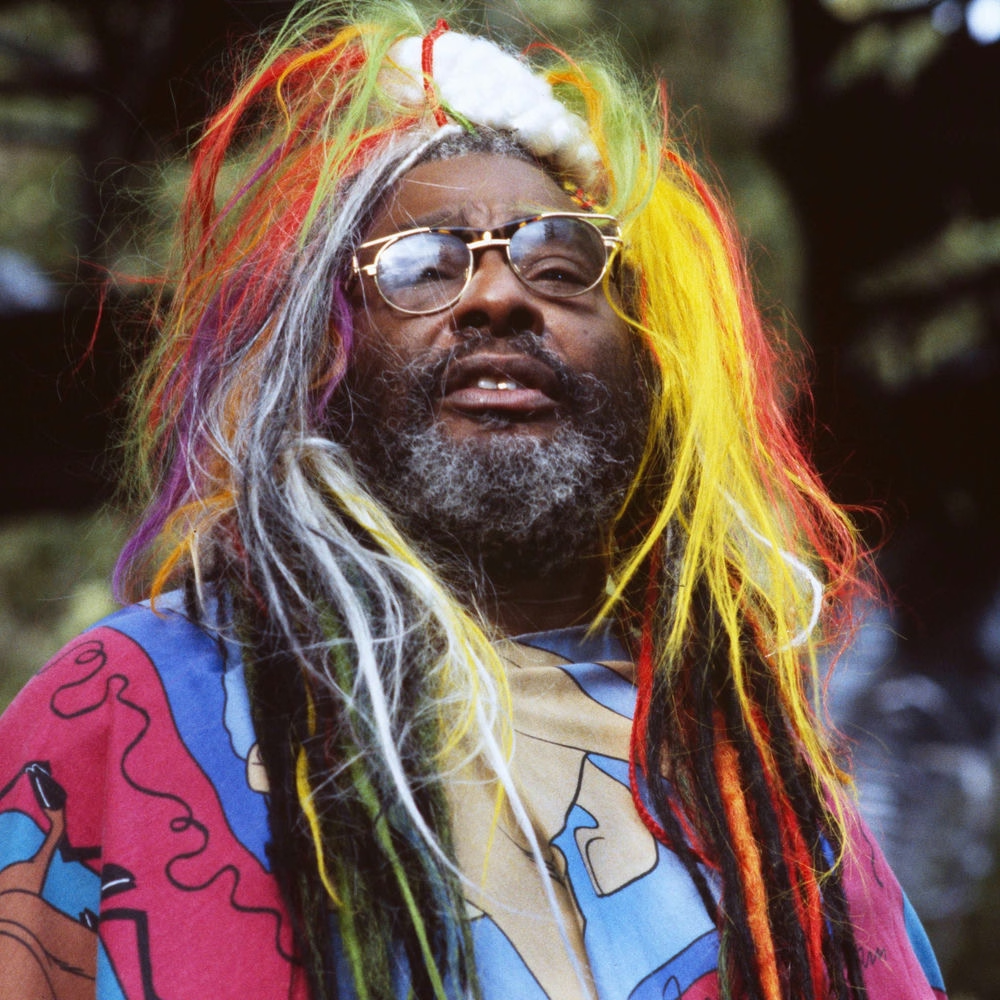
Image Credits

1,414 artist portraits across 5 genres (Rock, Jazz, Soul, Blues, Folk). 1,363 sourced from Wikipedia (Creative Commons / Public Domain), 50 from Deezer (promotional artwork).

Full attribution breakdown →

George Clinton

1941 –
Dr. Funkenstein

Born in Kannapolis, North Carolina in 1941, raised in New Jersey by a family that could not afford much but gave him a jukebox. George Clinton started in a doo-wop group called the Parliaments, singing harmonies in a barbershop in Plainfield, and ended up commanding the largest, strangest, most influential funk empire the world has ever seen. Working with Bootsy Collins and Sly Stone, he built a universe around it, complete with spaceships, superheroes, afrofuturist politicians, and a whole taxonomy of grooves.

0:30
0:30
0:30
0:30

James Brown invented funk. George Clinton built a universe around it.

The 1960s music industry was not ready for a Black artist who wanted to be Frank Zappa and James Brown at the same time. Clinton walked into a moment when Motown had polished Black music to a high gloss and Stax had ground it down to grit, and he decided to do neither. He took the Parliaments, split them into Parliament and Funkadelic, signed conflicting contracts with different labels, and spent the next decade untangling the legal mess while simultaneously creating some of the most vital music of the century. The cost was chaos: lawsuits, debt, drug addiction in the ranks, and a business structure that made no sense to anyone outside Clinton's head. But that chaos was also the engine. You cannot make orderly music from a orderly life. The P-Funk sound needed the chaos to breathe.

George Clinton interview 1990

"Atomic Dog 0:30" from 1982 is the late-era masterpiece, a track that Clinton recorded after the Parliament-Funkadelic machinery had mostly ground to a halt. It is minimal and maximal at the same time. That bassline is a single note repeated into infinity. The dog-bark samples, the call-and-response, the way Clinton half-sings half-preaches "why must I be like that? why must I chase the cat?" -- it is absurd and profound and somehow the funkiest thing ever committed to tape.

Computer Games (1982)

The song did not need a chord change. It did not need a bridge. It needed the pocket, and the pocket was infinite. "Atomic Dog" became one of the most sampled records in hip-hop history because it proved that funk could strip down to its skeleton and still move whole crowds.

Clinton is still alive as of this writing, which means the story is not over. He has been inducted into the Rock and Roll Hall of Fame, sampled by everyone from De La Soul to Snoop Dogg, and recognized as maybe the most radical mind in Black popular music. But the real legacy is in the permission he gave. He showed that Black musicians could be weird, could be cosmic, could be funny, could be intellectual without being pretentious, and could build a world that fans could live in. Parliament-Funkadelic was not a band. It was a republic. And George Clinton was its founding father, still laughing, still funky, still atomic.

Computer Games (1982) Computer Games (1982)
You Shouldn't-nuf Bit Fish (1983) You Shouldn't-nuf Bit Fish (1983)
R&B Skeletons in the Closet (1986) R&B Skeletons in the Closet (1986)
Randand B Skeletons In The Closet (1986) Randand B Skeletons In The Closet (1986)
Computer Games (1982)
You Shouldn't-nuf Bit Fish (1983)
Some of My Best Jokes Are Friends (1985)
R&B Skeletons in the Closet (1986)
The Cinderella Theory (1989)
Sample Some of Disc - Sample Some of D.A.T.
Volume 2 (1993)
Hey Man... Smell My Finger (1993)
Smell My Finger Demos (2002)
George Clinton & His Gangsters of Love (2008)
Straight From #1 Bimini Road (2020)
Randand B Skeletons In The Closet (1986)
funkp-funksoul
The Sunday Drop
One song. One story. Every Sunday.

No algorithms. No trending sections. Just a song someone loved and the story behind it. Delivered Sunday morning.

Free. No spam. Unsubscribe anytime.

Image Credits

1,414 artist portraits across 5 genres (Rock, Jazz, Soul, Blues, Folk). 1,363 sourced from Wikipedia (Creative Commons / Public Domain), 50 from Deezer (promotional artwork).

Full attribution breakdown →

0:00
0:00