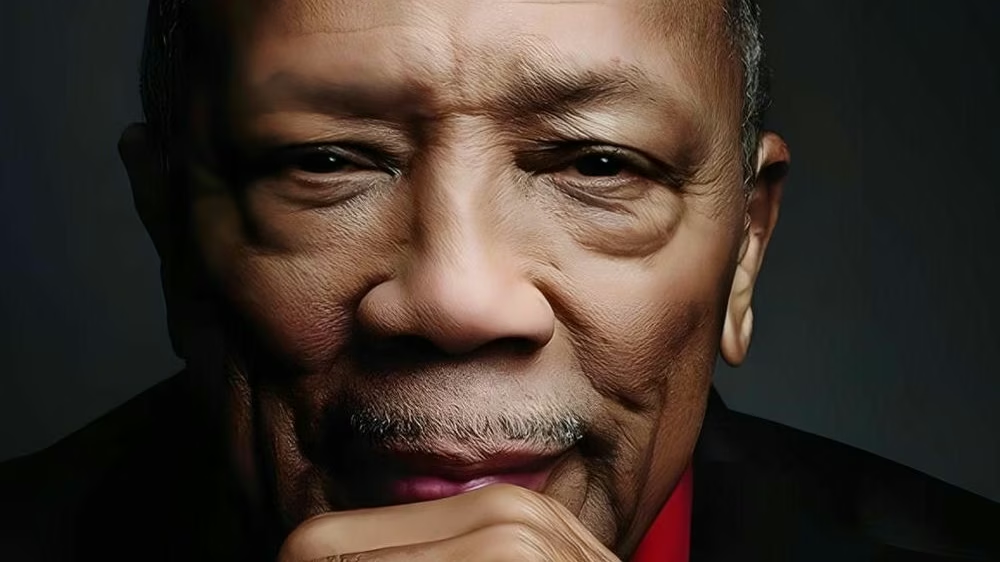
Quincy Jones
1933 – 2024 (91)
Q

It is possible to map the entire second half of twentieth-century American music through one man's address book. From the trumpet section of Lionel Hampton's band at sixteen to the producer's chair for the biggest album in history, the through line traces a single audacious proposition: that a kid from Chicago's South Side could arrange the universe itself if he just kept his hand on the baton. Quincy Jones didn't just make records -- he wired the whole house, ran the cables, and designed the acoustics.

0:30
0:30
0:30
0:30

The walls between genres were just obstacles to be removed, and he had a wrecking ball.

Born in Chicago in 1933, Jones found the trumpet early and never looked back. By his twenties he was writing arrangements for Count Basie, touring Europe with Jazz at the Philharmonic, and scoring Hollywood films -- a path that required him to be fluent in bop, swing, and cinema orchestration simultaneously. The cost of that range was depth in any single idiom; purists would always grumble that he spread himself too thin. But Jones understood that the real work wasn't mastering one room -- it was building the corridors between them. He became the connective tissue between genres that had no business talking to each other, the common language that allowed disparate sounds to coexist in the same arrangement. The breadth was not a weakness. It was the whole point, and he proved it every time he stepped into the studio.

Quincy Jones interview 1990

"Soul Bossa Nova" was the calling card, a track so breezy and confident that it sounded like the whole 1960s exhaled at once. The tune brought Brazilian rhythm into the American jazz pocket and made the hybrid feel inevitable. But that was just one node in a career that stretched from producing Frank Sinatra's greatest late-period albums to overseeing "We Are the World" to crafting Michael Jackson's "Thriller" -- an album that sold more copies than anyone had ever imagined possible. Jones treated the recording studio like a laboratory and the control room like a command center.

Swedish American All Stars (1953)

Every arrangement he touched carried his signature: precision without stiffness, warmth without sentiment, ambition without pretension. The man who could do everything became the man who did everything, and the industry has never stopped trying to catch up.

He died in 2024 at ninety-one, having worked past the point where most artists retire twice over. The crate of his career contains funk, jazz, soul, R&B, film scores, television themes, and a humanitarian anthem that half the planet sang at once. Every producer who reaches for a wider palette, every arranger who hears connections where others hear boundaries, every musician who refuses to be told what lane they belong in -- they're all dialing up a frequency that Q first set to broadcast.

Quincy Jones was profiled in the documentary, Quincy, in 2018.

Image Credits

1,414 artist portraits across 5 genres (Rock, Jazz, Soul, Blues, Folk). 1,363 sourced from Wikipedia (Creative Commons / Public Domain), 50 from Deezer (promotional artwork).

Full attribution breakdown →

Quincy Jones

1933 – 2024 (91)
Q

It is possible to map the entire second half of twentieth-century American music through one man's address book. From the trumpet section of Lionel Hampton's band at sixteen to the producer's chair for the biggest album in history, the through line traces a single audacious proposition: that a kid from Chicago's South Side could arrange the universe itself if he just kept his hand on the baton. Quincy Jones didn't just make records -- he wired the whole house, ran the cables, and designed the acoustics.

0:30
0:30
0:30
0:30

The walls between genres were just obstacles to be removed, and he had a wrecking ball.

Born in Chicago in 1933, Jones found the trumpet early and never looked back. By his twenties he was writing arrangements for Count Basie, touring Europe with Jazz at the Philharmonic, and scoring Hollywood films -- a path that required him to be fluent in bop, swing, and cinema orchestration simultaneously. The cost of that range was depth in any single idiom; purists would always grumble that he spread himself too thin. But Jones understood that the real work wasn't mastering one room -- it was building the corridors between them. He became the connective tissue between genres that had no business talking to each other, the common language that allowed disparate sounds to coexist in the same arrangement. The breadth was not a weakness. It was the whole point, and he proved it every time he stepped into the studio.

Quincy Jones interview 1990

"Soul Bossa Nova" was the calling card, a track so breezy and confident that it sounded like the whole 1960s exhaled at once. The tune brought Brazilian rhythm into the American jazz pocket and made the hybrid feel inevitable. But that was just one node in a career that stretched from producing Frank Sinatra's greatest late-period albums to overseeing "We Are the World" to crafting Michael Jackson's "Thriller" -- an album that sold more copies than anyone had ever imagined possible. Jones treated the recording studio like a laboratory and the control room like a command center.

Swedish American All Stars (1953)

Every arrangement he touched carried his signature: precision without stiffness, warmth without sentiment, ambition without pretension. The man who could do everything became the man who did everything, and the industry has never stopped trying to catch up.

He died in 2024 at ninety-one, having worked past the point where most artists retire twice over. The crate of his career contains funk, jazz, soul, R&B, film scores, television themes, and a humanitarian anthem that half the planet sang at once. Every producer who reaches for a wider palette, every arranger who hears connections where others hear boundaries, every musician who refuses to be told what lane they belong in -- they're all dialing up a frequency that Q first set to broadcast.

Quincy Jones was profiled in the documentary, Quincy, in 2018.
Swedish American All Stars (1953) Swedish American All Stars (1953)
This Is How I Feel About Jazz (1956) This Is How I Feel About Jazz (1956)
Jazz Abroad (1957) Jazz Abroad (1957)
Swedish American All Stars (1953)
This Is How I Feel About Jazz (1956)
Jazz Abroad (1957)
Go West
Man! (1957)
The Great Wide World of Quincy Jones (1959)
Et voilà ! (1959)
The Birth of a Band (1959)
I Dig Dancers (1960)
If You Go (1961)
Big Band Bossa Nova (1962)
Plays Hip Hits (1963)
Golden Boy (1964)
Quincy Jones Explores the Music of Henry Mancini (1964)
The Deadly Affair (The Original Sound Track Album) (1966)
Walking in Space (1969)
funksouljazzr&b
The Sunday Drop
One song. One story. Every Sunday.

No algorithms. No trending sections. Just a song someone loved and the story behind it. Delivered Sunday morning.

Free. No spam. Unsubscribe anytime.

Image Credits

1,414 artist portraits across 5 genres (Rock, Jazz, Soul, Blues, Folk). 1,363 sourced from Wikipedia (Creative Commons / Public Domain), 50 from Deezer (promotional artwork).

Full attribution breakdown →

0:00
0:00