Funkadelic tracklist updated 08/2026
The late 1960s offered Black musicians a menu of identities: the soul man, the protest poet, the crossover artist, the entertainer. Funkadelic rejected the menu entirely. They walked into a room where Sly Stone had already begun to blur the lines between funk and rock and they pushed that blur into a blur. Eddie Hazel's guitar on "Maggot Brain" is not a solo -- it is a confession, ten minutes of feedback and feeling that Clinton reportedly recorded after telling Hazel to play like his mother had just died. The cost of this freedom was instability. Lineups changed constantly. Contracts tangled. Money disappeared. Funkadelic never had a stable hit-making lineup because Clinton treated the band like a rotating cast for a play that never closed.
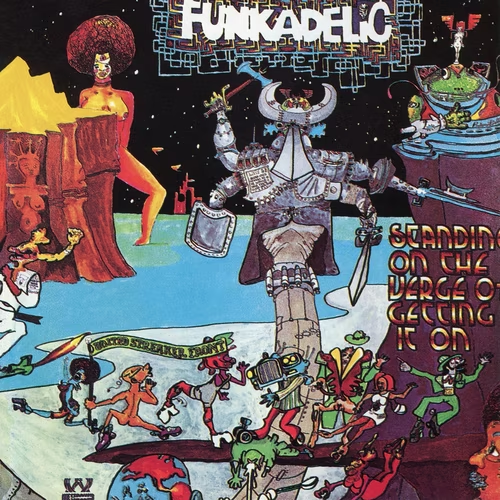
"One Nation Under a Groove" from 1978 is the mission statement. The track opens with a bassline that feels like it has been running for years before the record started, then the guitars lock in, then the horns, then Clinton's voice -- ragged, funny, preacher-adjacent. The lyric is a manifesto wrapped in a party: "One nation under a groove, gettin' down just for the funk of it." It is not escapism. It is a political argument that liberation begins in the body, that the groove is a form of knowledge, that dancing together is a practice of solidarity. Funkadelic took the funk rhythm section and draped it in acid-rock guitar, gospel choirs, science fiction, and the kind of humor that only comes from people who have seen enough to know that laughter is a survival tool.
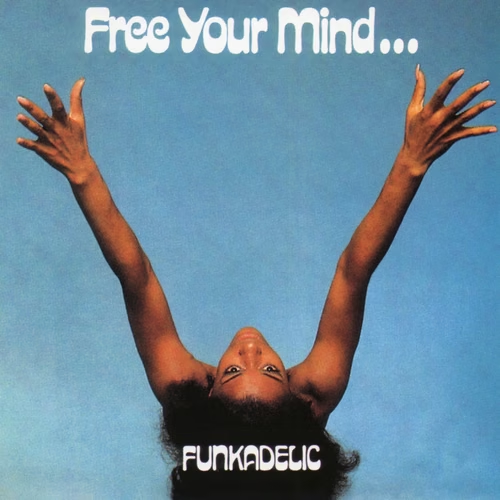
Funkadelic dissolved as a recording entity around 1981, but the separation from Parliament had already created a universe. The P-Funk Mothership -- the mythology, the aesthetic, the whole cosmology -- would not have existed without Funkadelic's willingness to be weird. Every band since that has tried to make Black rock music, from Living Colour to TV on the Radio, owes something to Plainfield. Funkadelic did not just make songs. They built a world, and that world is still accepting new residents. Free your mind and your ass will follow. That was never a slogan. It was a map.
Funkadelic dissolved as a recording entity around 1981, but the separation from Parliament had already created a universe. The P-Funk Mothership -- the mythology, the aesthetic, the whole cosmology -- would not have existed without Funkadelic's willingness to be weird. Every band since that has tried to make Black rock music, from Living Colour to TV on the Radio, owes something to Plainfield. Funkadelic did not just make songs. They built a world, and that world is still accepting new residents. Free your mind and your ass will follow. That was never a slogan. It was a map.